Reflectly and Puffy both help you journal and track your emotional well-being, but they approach the task from very different angles. Reflectly is a polished, text-based journaling and mood tracking app with over 10 million downloads. It uses AI to personalize prompts and offers a visually appealing interface that makes daily check-ins feel easy. Puffy is a voice-first journaling app that lets you speak your entries aloud, transcribes them with AI, and tracks your emotions using a granular feelings wheel.
If you are choosing between these two apps, the decision comes down to how you prefer to capture your thoughts and how deeply you want to track your emotions. This article breaks down both apps in detail so you can make an informed choice.
Quick Verdict
Choose Reflectly if you want a quick, visually polished daily mood tracker with AI-generated text prompts, you prefer typing short entries, and you want an app with a large user base and availability on both iOS and Android.
Choose Puffy if you want to journal by speaking rather than typing, you want deeper emotion tracking through a feelings wheel with sub-emotions, you value offline support and local-first data storage, or you want AI-powered transcription that turns your voice into searchable text.
Feature Comparison
Here is a side-by-side look at what each app provides.
| Feature | Puffy | Reflectly |
|---|---|---|
| Primary Input | Voice | Text |
| Voice Recording | ✓ | ✗ |
| AI Transcription | ✓ | ✗ |
| Text Journaling | Transcript only | ✓ |
| AI Prompts | ✗ | ✓ |
| Mood Tracking | Feelings wheel (6 primary + sub-emotions) | Simple mood scale |
| Emotion Trends | ✓ | ✓ |
| AI Insights | ✓ | ✓ |
| Offline Support | ✓ | ✓ |
| Free Tier | ✓ | ✗ |
| Platforms | iOS | iOS, Android |
| Starting Price | $4.99/mo | $9.99/mo |
Reflectly: Polished Mood Tracking with AI Prompts
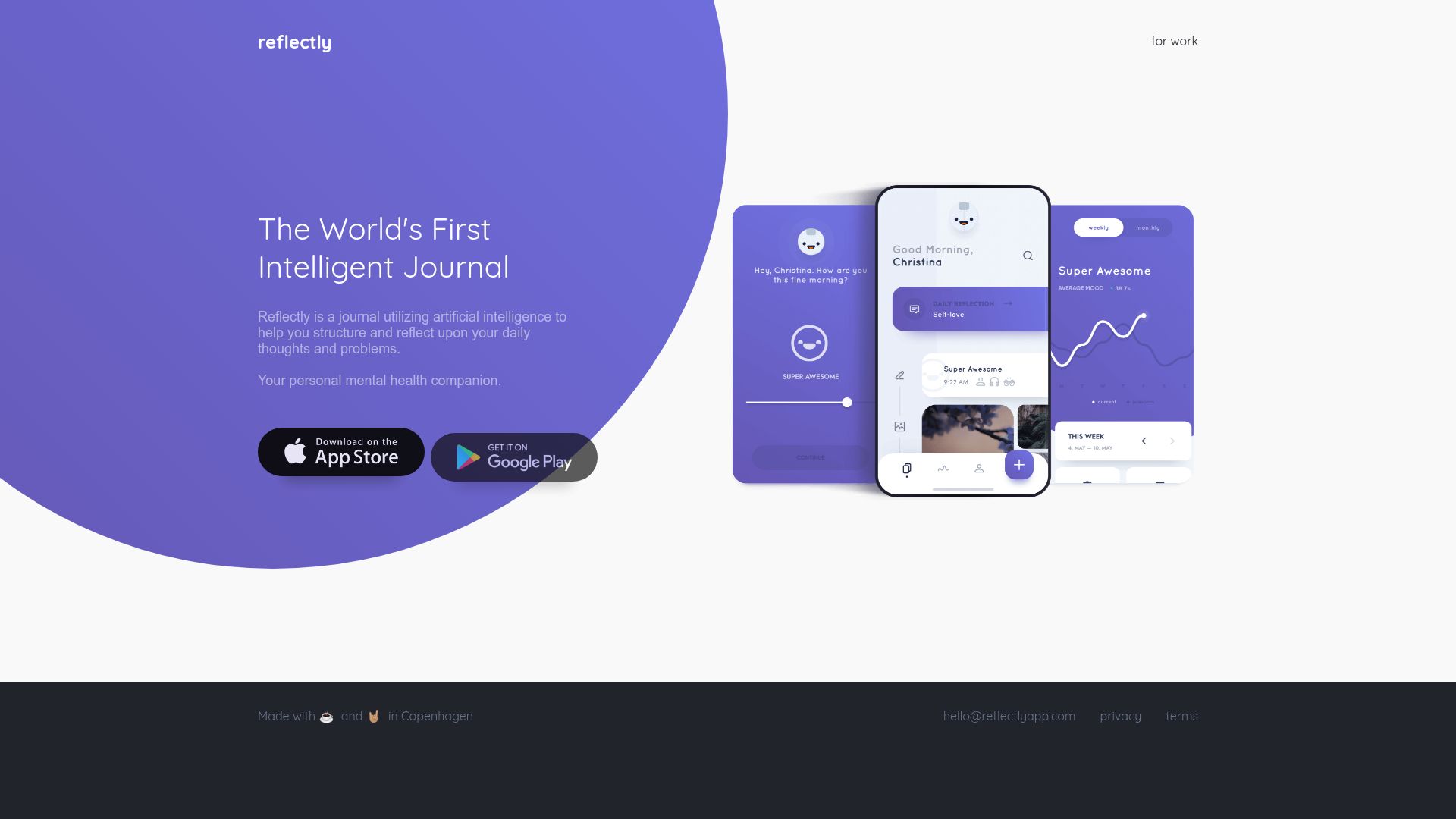
Reflectly launched in 2017 and has grown into one of the most popular journaling apps in the world, with over 10 million downloads across iOS and Android. It positions itself as an "intelligent journal" that uses AI to help you develop a positive mindset.
The daily experience with Reflectly follows a structured flow. You open the app, select your current mood on a simple scale (usually represented by emoji faces or a slider), and then respond to an AI-generated prompt. The prompts are designed to encourage positive reflection: "What is something good that happened today?" or "What are you grateful for?" After writing, Reflectly may offer a brief AI-generated insight or affirmation.
The app's visual design is one of its biggest strengths. Reflectly uses soft gradients, rounded shapes, and calming color palettes that make the experience feel inviting. The interface is clean and intuitive. You can complete a journal entry in under two minutes, which makes it easy to maintain as a daily habit.
Reflectly tracks your mood over time and presents this data in charts and summaries. You can see your mood distribution across a week or month, identify trends, and review past entries organized by date. The mood tracking is straightforward but relatively simple, typically using a five-point or seven-point scale.
One important detail: Reflectly does not offer a meaningful free tier. After a short trial period, the app requires a paid subscription to continue using it. The pricing starts at $9.99 per month, which makes it one of the more expensive journaling apps on the market.
Puffy: Voice-First Journaling with a Feelings Wheel

Puffy was built for people who find text-based journaling tedious or slow. Instead of typing, you talk. Open the app, tap one button, and start speaking about whatever is on your mind. When you finish, Puffy transcribes your recording using AI (OpenAI Whisper) and formats the transcript into clean, readable text.
After each entry, Puffy prompts you to identify your emotions using a feelings wheel. The wheel is based on established emotional taxonomy and offers six primary emotions (joy, love, surprise, fear, sadness, anger), each with multiple sub-emotions beneath it. This lets you distinguish between "frustrated" and "furious," or between "peaceful" and "euphoric," with a level of precision that a simple mood slider cannot match.
Over time, Puffy visualizes your emotional data in charts and trend views. You can see which emotions dominate your entries, how your emotional landscape shifts across weeks and months, and whether certain patterns correlate with events in your life.
Puffy works offline. Your entries are stored on your device first and synced to the cloud as a secondary step. You can journal anywhere, with or without an internet connection. The app is currently available on iOS, with Android support planned.
The Journaling Experience
The day-to-day experience of using these two apps feels very different.
Reflectly follows a structured, guided flow. You select your mood, respond to a prompt, and the app wraps up with an insight or affirmation. The experience is quick, pleasant, and requires minimal effort. It works well as a daily ritual that takes one to two minutes. However, the structured nature means you are typically responding to what the app asks rather than exploring your own thoughts freely. Entries tend to be short, usually a few sentences to a paragraph.
Puffy follows an open, unstructured flow. You press record and talk about whatever matters to you in that moment. There are no prompts directing your thinking. An entry might last 30 seconds or 15 minutes. Some entries are about a specific event. Others are rambling streams of consciousness where you process something complex. The lack of structure means you might occasionally feel unsure about what to talk about, but it also means your entries are authentically your own.
Speed is another factor. Voice is inherently faster than typing. Most people speak at 130 to 150 words per minute and type at 40 to 60 words per minute on a phone. A five-minute Puffy entry captures roughly 700 words. Typing 700 words on a phone would take 12 to 17 minutes. If you want to journal in depth but do not have much time, voice is a significant advantage.
Emotion Tracking Depth
Both apps track your mood, but the depth of that tracking differs substantially.
Reflectly uses a simple mood scale. You select how you are feeling from a small set of options, typically ranging from "very bad" to "very good" with a few steps in between. This is quick and easy, but it lacks nuance. "Feeling bad" could mean you are sad, anxious, angry, frustrated, disappointed, lonely, or overwhelmed. A simple scale collapses all of those distinct emotional states into one point on a spectrum.
Puffy uses a feelings wheel with six primary emotions and dozens of sub-emotions. When you select "sadness," you then choose from options like "disappointed," "lonely," "grieving," "melancholic," or "hopeless." This granularity matters for two reasons. First, it builds emotional vocabulary. Research in affective science shows that people who can label their emotions with specificity ("emotional granularity") tend to have better emotional regulation. Second, it produces richer trend data. Knowing you felt "anxious" five times this week is more actionable than knowing you "felt bad" five times.
AI Features
Reflectly uses AI primarily for prompt generation and personalization. The app learns your journaling patterns and adjusts its prompts accordingly. It also generates brief insights and positive affirmations based on your entries. The AI is designed to encourage a positive, growth-oriented mindset.
Puffy uses AI for transcription and insight generation. The transcription pipeline converts your voice to text using OpenAI Whisper, then formats the output for readability. Puffy also generates insights based on your entries and emotional patterns over time. These insights are reflective rather than prescriptive; they highlight patterns and themes without telling you what to do.
A key difference: Reflectly's AI actively shapes your journaling experience through prompts, while Puffy's AI processes your input after the fact. Reflectly's approach is more interactive. Puffy's approach is more hands-off.
Pricing
Reflectly does not offer a usable free tier. After a brief trial period, the app locks behind a paywall. Subscription pricing starts at $9.99 per month, with discounts for annual billing. This makes Reflectly one of the more expensive journaling apps on the market, especially considering it does not include voice recording or transcription.
Puffy offers a free tier with a limited number of entries per month, enough to try the app and see if it fits your workflow. The pro plan costs $4.99 per month and unlocks unlimited recording, full transcription, all emotion tracking features, and cloud sync. At roughly half the monthly cost of Reflectly, Puffy offers more features per dollar.
Privacy and Offline Support
Reflectly supports offline use, which is a positive. You can write entries without an internet connection and they will sync later. However, AI features may require connectivity to function.
Puffy was architected as offline-first from the beginning. Entries are saved to local device storage immediately. Cloud sync is a secondary process that runs when connectivity is available. Your data always exists on your device regardless of server status. Audio files are sent to servers for transcription, but the design philosophy prioritizes local data ownership above all else.
Platforms
Reflectly is available on both iOS and Android. This is a meaningful advantage for Android users who want a polished journaling app. There is no web app or desktop app.
Puffy is currently available on iOS only. Android support is on the roadmap but not yet released. If you use an Android phone, Reflectly is the only option between these two.
Where Reflectly Wins
Reflectly is a popular app for good reasons, and it is the better choice in several scenarios.
- Polished, inviting visual design. Reflectly is one of the most visually appealing journaling apps available. The soft gradients, gentle animations, and calming color palette make journaling feel like a pleasant ritual rather than a chore. The UX is refined in a way that reflects years of design iteration.
- Large user base and social proof. With over 10 million downloads, Reflectly has a proven track record. A large user base typically means the app is stable, well-maintained, and will continue receiving updates. There is comfort in knowing you are using a product that millions of others trust.
- Android support. If you use an Android device, Reflectly is available and Puffy is not. This is a decisive factor for a large segment of potential users.
- Structured daily routine. Reflectly's guided prompts create a consistent, low-effort daily journaling habit. You do not need to decide what to write about; the app provides a framework. For people who thrive with structure, this is a genuine advantage.
- Quick completion time. A Reflectly entry takes one to two minutes. If you want a minimal daily check-in without investing significant time, Reflectly delivers that experience efficiently.
Where Puffy Wins
- Voice-first means faster, deeper entries. Speaking is three to four times faster than typing on a phone. A five-minute Puffy session captures roughly 700 words, which would take 15 minutes or more to type. Voice also tends to produce more honest, less edited content because you are thinking out loud rather than composing sentences.
- Deeper emotion tracking with the feelings wheel.Puffy's feelings wheel provides a structured taxonomy of emotions that is far more granular than Reflectly's mood scale. Instead of "feeling okay," you can identify that you are feeling "restless" or "apprehensive" or "melancholic." This precision leads to richer trend data and stronger emotional self-awareness.
- AI transcription creates searchable entries. Your voice entries in Puffy become clean, readable text. You can search through past entries by keyword, scan transcripts quickly, and review what you said without re-listening to audio. This is a major advantage for long-term journaling.
- Local-first data architecture. Puffy's offline-first design means your data lives on your device first. For people who are cautious about cloud services handling their most personal thoughts, this provides meaningful privacy benefits.
- Free tier available. Puffy offers a functional free tier. Reflectly effectively requires a paid subscription after a short trial. If you want to try before you commit financially, Puffy is more accessible.
- Lower price point. At $4.99 per month compared to Reflectly's $9.99 per month, Puffy costs roughly half as much while offering voice recording, AI transcription, and a feelings wheel that Reflectly does not have.
Final Recommendation
Reflectly and Puffy serve overlapping but distinct audiences.
Choose Reflectly if you want a quick, visually beautiful daily mood check-in with guided prompts. It is especially well suited for people who are new to journaling, prefer typing, use an Android device, and want a structured routine that takes minimal time. The main downsides are the higher price, the shallow mood tracking, and the lack of voice input.
Choose Puffy if you want a deeper journaling practice built around voice and emotional self-awareness. It is especially well suited for people who dislike typing, want to track their emotions with real precision, value offline access, and prefer their data to live on their own device. The main downsides are the iOS-only availability and the lack of guided prompts for people who want structure.
Both apps can help you build a journaling habit. The most important factor is not which app has the best feature list; it is which app feels natural enough that you will use it every day. If speaking feels easier than typing, start with Puffy. If tapping a mood emoji and responding to a short prompt feels more your speed, start with Reflectly. Both are worth trying.