Tracking how you feel sounds simple, but it raises a surprisingly deep question: what exactly are you tracking? Your general mood? A specific emotion? The intensity of that emotion? The circumstances that triggered it? Different mood tracker apps answer this question in very different ways, and the approach an app takes determines what kind of self-awareness you can build from it.
Some apps reduce your emotional life to a single data point per day: good, okay, or bad. Others capture granular emotions with sub-categories and intensity levels. A few use AI or voice analysis to detect what you are feeling without requiring you to label it yourself. The best choice depends on what you want to learn about yourself and how much effort you are willing to put in each day.
We tested five of the most popular mood and emotion tracking apps of 2026. Here is what we found.
Mood Tracking vs. Emotion Tracking
Before diving into the apps, it is worth distinguishing between two concepts that often get used interchangeably but are meaningfully different.
Mood tracking captures your general emotional state on a simple scale. Think of it as measuring the weather: sunny, cloudy, or stormy. You know the overall conditions, but you do not know the specific atmospheric dynamics producing them. Most mood trackers use a three-to-five point scale, sometimes with labels like "great," "good," "meh," "bad," and "awful."
Emotion tracking goes deeper. Instead of asking "How do you feel?" on a generic scale, it asks "What specific emotion are you experiencing?" This is the difference between saying "I feel bad" and saying "I feel disappointed because I expected more from that conversation." Research on emotional granularity (the ability to make fine-grained distinctions between emotions) shows that people who can identify their specific emotions regulate them more effectively.
Both approaches have value. Mood tracking is faster and simpler. Emotion tracking provides richer self-knowledge. Some apps bridge the two by starting with a broad mood selection and then letting you drill down into specifics.
The Five Best Mood Tracker Apps
Puffy: Deepest Emotion Tracking
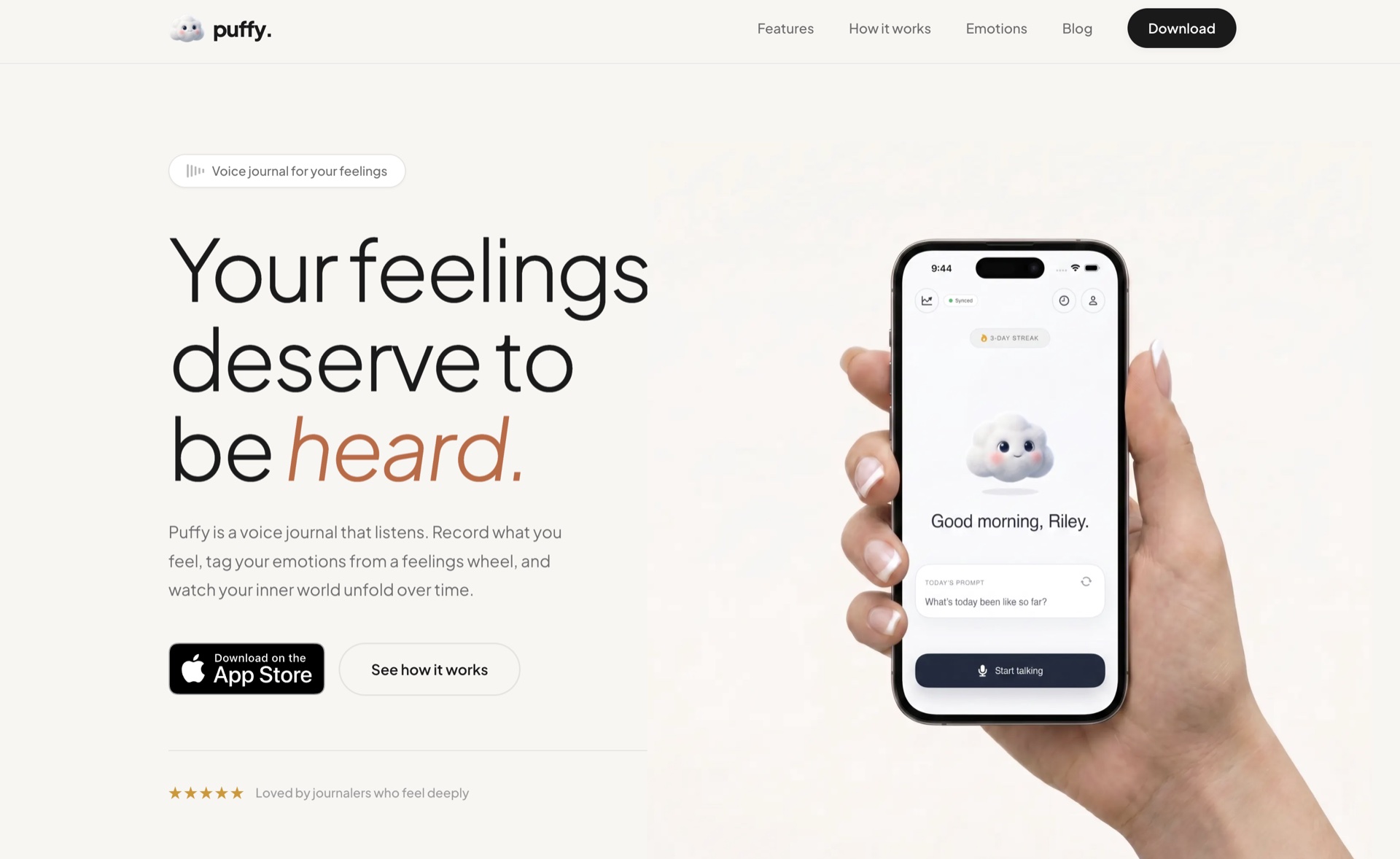
Puffy approaches emotion tracking differently from every other app on this list. Instead of asking you to manually select a mood or emotion, Puffy listens to what you say. You record a short voice entry (talking about your day, a situation, or whatever is on your mind), and Puffy's AI identifies the emotions present in your speech. It uses a feelings wheel model with six primary emotions (joy, love, surprise, fear, sadness, anger) and dozens of sub-emotions for granularity.
The result is emotion tracking that happens passively. You do not need to pause and introspect about which emoji matches your state. You just talk, and the patterns emerge over time. Puffy's trend view shows you which emotions appear most frequently, how they shift across weeks, and which sub-emotions cluster together. For people who want deep emotional insight without the manual effort of labeling, this is the most powerful tool available.
The trade-off is that Puffy requires you to speak for at least a minute or two. If you want a five-second check-in, this is not the right app. But if you are willing to invest two minutes of talking, the depth of insight is unmatched.
Daylio: Simplest Mood Tracking
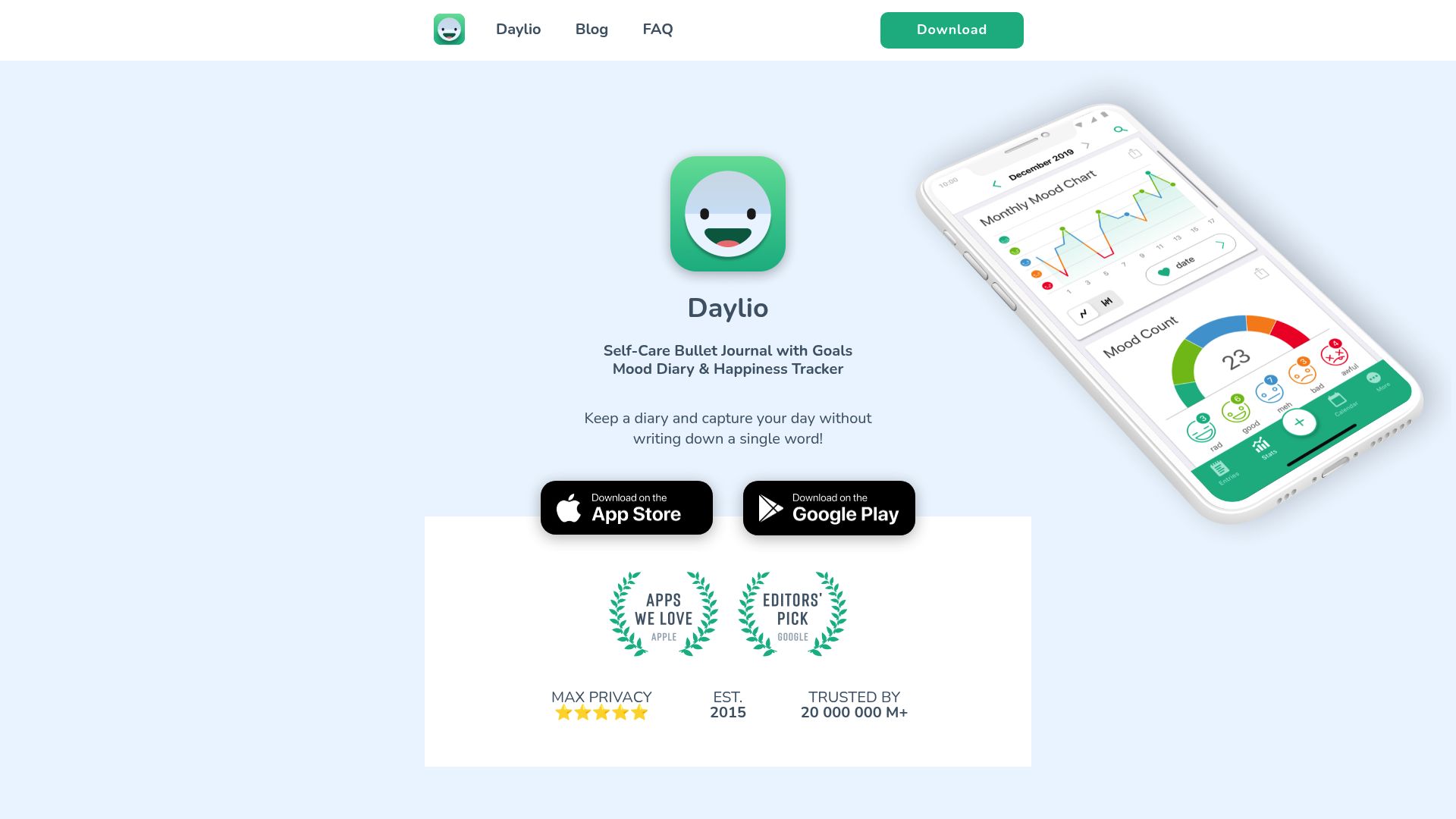
Daylio is the gold standard for simple mood tracking. You select one of five mood levels (represented by colored faces), tap the activities you did that day, and optionally add a short note. The entire process takes 10 to 15 seconds. Daylio then visualizes your moods over time in a calendar view, chart, and statistics dashboard.
Daylio's strength is its simplicity and the correlation features it builds from your data. After a few weeks of consistent tracking, it can show you which activities are associated with better or worse moods. You might notice that days with exercise correlate with higher moods, or that certain social activities consistently precede lower ones. This kind of pattern recognition is valuable even at the broad mood level.
The limitation is granularity. Five mood levels cannot capture the difference between feeling anxious and feeling disappointed. Both might register as a "3 out of 5," but they call for very different responses. If broad patterns are enough for you, Daylio is excellent. If you want to understand the texture of your emotional life, you will need something deeper.
Reflectly: AI Mood Journal
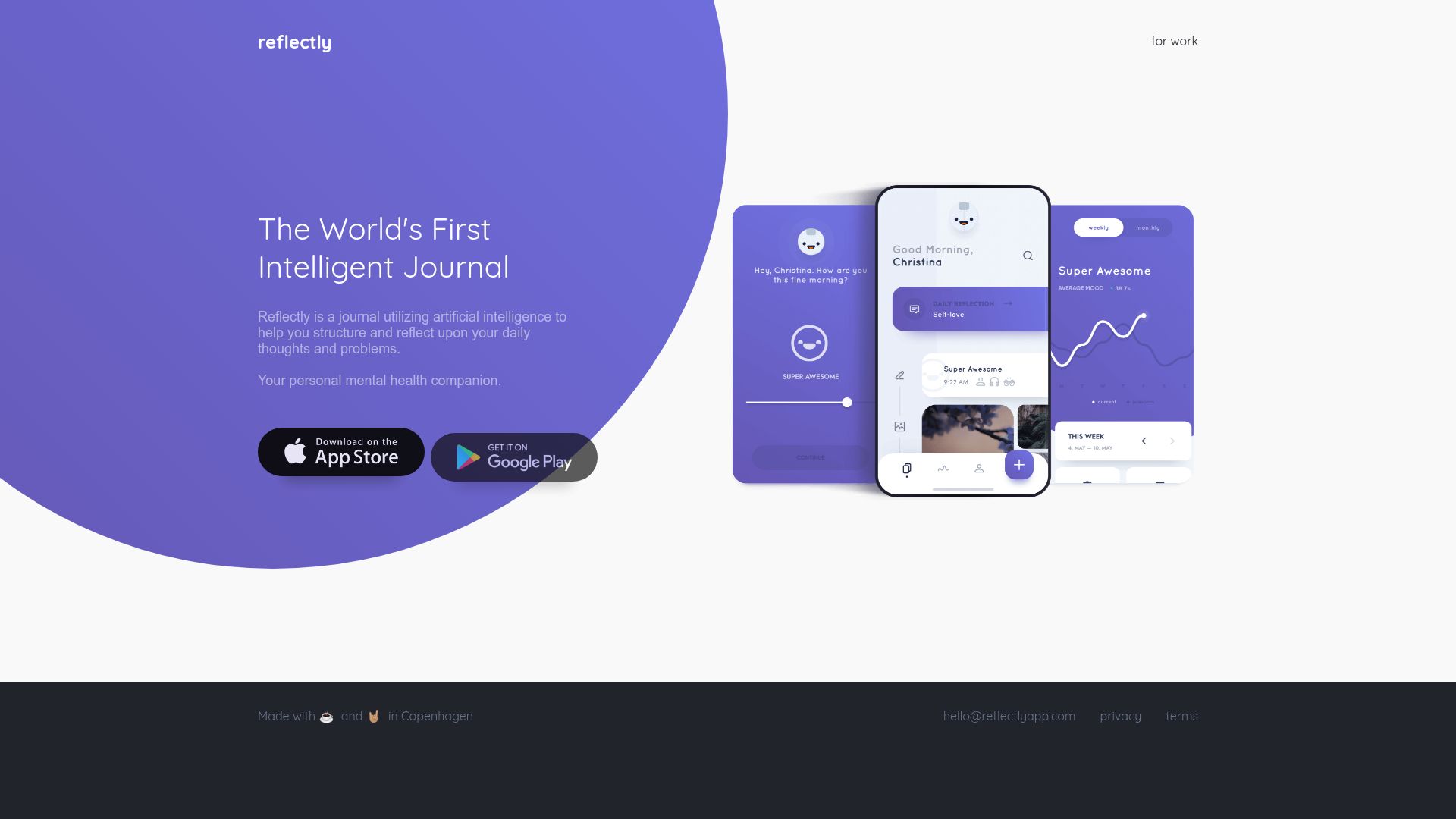
Reflectly sits at the intersection of mood tracking and journaling. You start each entry by selecting your mood, then the app guides you through a few short prompts using AI. The prompts adapt based on your responses, creating a semi-structured reflection that takes about two to three minutes.
The mood tracking component is straightforward: a sliding scale from negative to positive. Where Reflectly adds value is in the journaling layer on top. By writing (even briefly) about what drove your mood, you create context that pure mood tracking misses. Looking back at a month of entries, you can see not just that Tuesday was a bad day but why it was a bad day.
Reflectly works best for people who want more depth than Daylio but less commitment than a full journaling practice. The guided prompts keep the process manageable while adding meaningful context to your mood data.
Stoic: CBT-Based Tracking
Stoic takes a therapeutic approach to mood tracking. In addition to logging your mood and emotions, the app includes exercises drawn from cognitive behavioral therapy (CBT), Stoic philosophy, and positive psychology. You might be asked to identify cognitive distortions in your thinking, practice gratitude, or reframe a negative experience.
The mood and emotion tracking in Stoic is more nuanced than Daylio's but less automated than Puffy's. You manually select from a list of emotions and rate their intensity. Over time, Stoic shows you trends and correlations. The CBT exercises add a layer of active intervention that most trackers lack; instead of just recording how you feel, you are working to understand and shift your emotional patterns.
Stoic is a strong choice for people who want their mood tracker to double as a lightweight therapy tool. The trade-off is time: completing a full daily check-in with exercises can take five to ten minutes, which is significantly more than a simple mood tap.
Bearable: Health and Mood Correlation
Bearable takes a broader view by tracking mood alongside physical health metrics: sleep, medication, symptoms, diet, exercise, and more. The goal is to find correlations between your physical state and your emotional one. After accumulating enough data, Bearable can show you that your mood drops on days when you sleep less than six hours, or that a particular medication consistently correlates with irritability.
The mood tracking itself is a simple scale, similar to Daylio. Where Bearable stands apart is in the richness of the factors it tracks alongside mood. If you suspect that physical health variables are affecting your emotional state (and research strongly suggests they do), Bearable provides the data to test those hypotheses.
The downside is the input burden. Tracking mood, sleep, symptoms, diet, and exercise every day requires commitment. Bearable is best for people who are already data-oriented and enjoy quantifying their health. If you just want emotional insight with minimal effort, simpler options will serve you better.
Comparison Table
| Feature | Puffy | Daylio | Reflectly | Stoic | Bearable |
|---|---|---|---|---|---|
| Tracking method | Voice (auto-detected) | Tap (5-point scale) | Mood slider + prompts | Manual emotion selection | Multi-factor logging |
| Emotion granularity | High (feelings wheel) | Low | Medium | Medium-high | Low-medium |
| Manual input required | Speak 1-2 min | 15 seconds | 2-3 minutes | 5-10 minutes | 3-5 minutes |
| Activity correlation | ✗ | ✓ | ✗ | ✗ | ✓ |
| Health data integration | ✗ | ✗ | ✗ | ✗ | ✓ |
| CBT exercises | ✗ | ✗ | ✗ | ✓ | ✗ |
| AI features | Transcription + emotion detection | None | Adaptive prompts | None | Correlation analysis |
| Best for | Deep emotional insight | Simple daily logging | Guided reflection | Therapeutic self-work | Health + mood patterns |
Which App Is Best for You?
The right mood tracker depends on what question you are trying to answer about yourself.
- "I want to understand my specific emotions." Use Puffy. Its feelings wheel model and automatic emotion detection provide the deepest emotional granularity with the least manual effort. You will learn whether you are experiencing frustration, disappointment, or resentment, not just "bad."
- "I want the simplest possible daily check-in." Use Daylio. Fifteen seconds per day is a commitment almost anyone can maintain, and the activity correlations are genuinely useful.
- "I want mood tracking with some journaling." Use Reflectly. The guided prompts add context to your mood data without requiring you to write at length.
- "I want therapeutic tools alongside tracking." Use Stoic. The CBT exercises help you not just observe your emotions but actively work with them.
- "I think my physical health affects my mood." Use Bearable. Its multi-factor tracking can reveal connections between sleep, diet, exercise, and emotional state.
The Case for Emotion Tracking over Mood Tracking
If you are reading this article, you probably already sense that "fine" is not a very useful answer to "How are you?" The same intuition applies to mood tracking. Knowing that you had a "3 out of 5" day tells you something, but not much. Knowing that you felt a mix of anticipation and anxiety about an upcoming project, with an undercurrent of resentment toward a colleague, tells you a lot.
Psychologist Lisa Feldman Barrett's research on emotional granularity has shown that people who can distinguish between closely related emotions (like irritation vs. frustration vs. anger) are better at regulating those emotions. They choose more effective coping strategies because they understand, with precision, what they are dealing with.
Mood tracking is a good starting point. If you have never tracked how you feel at all, even a simple five-point scale will reveal patterns you did not notice before. But if you want to develop genuine emotional intelligence, consider graduating to an emotion tracker that captures the specificity of your inner life. Your feelings are not simple, and the tools you use to understand them should not be either.
Start Tracking Today
Every app on this list offers a free tier or free trial. Pick the one that matches your goals, install it, and commit to one week of daily tracking. That is enough time to see whether the habit sticks and whether the insights feel valuable. If you want the deepest emotion tracking with the least manual effort, start with Puffy. It is free to download on iOS and Android, and your first voice entry takes less than two minutes.