What Are Primary Emotions?
Primary emotions are the foundational feelings from which more complex emotional experiences emerge. Think of them as the primary colors of your inner life. Just as red, blue, and yellow combine to create an infinite spectrum of hues, primary emotions blend, overlap, and layer to produce the full richness of human emotional experience. Nostalgia, for instance, is often a blend of joy and sadness. Jealousy combines anger, fear, and sadness. These complex states are not random; they grow from a small set of core feelings.
Different researchers have proposed different lists of primary emotions. Paul Ekman's classic model identified six universal emotions based on facial expression research across cultures. Robert Plutchik's wheel of emotions proposed eight. More recent constructionist approaches, like those of Lisa Feldman Barrett, question whether emotions are truly universal categories at all. Despite these debates, the practical value of a primary emotion framework remains strong: it gives people a starting point for understanding what they feel.
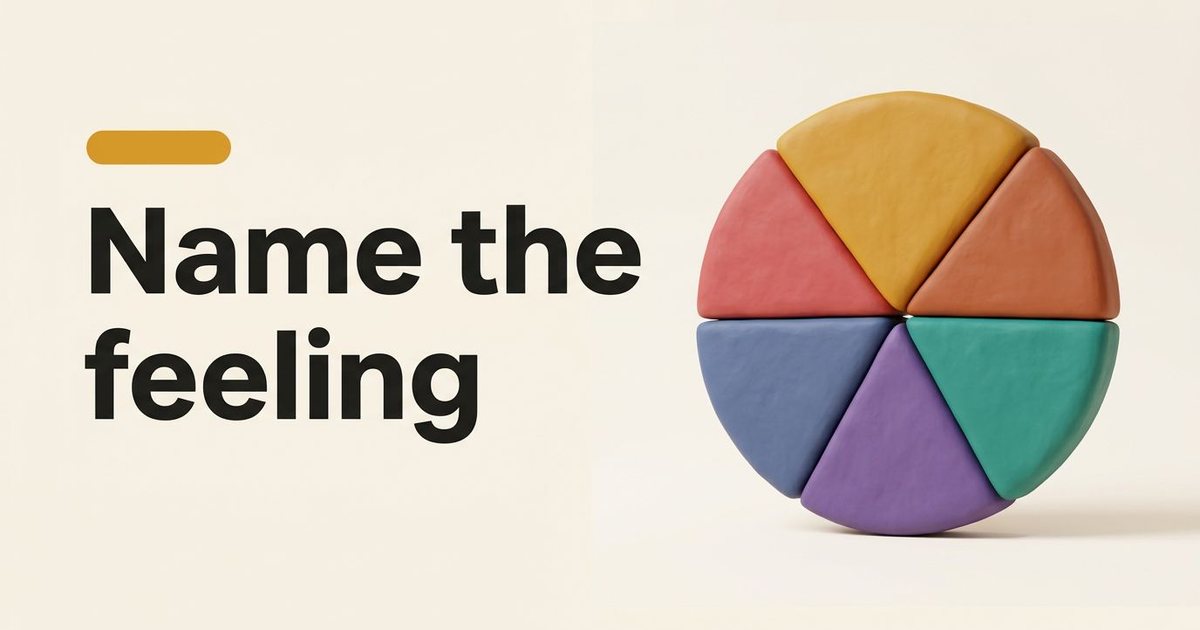
The model used by Puffy recognizes six primary emotions: joy, love, surprise, fear, sadness, and anger. This set was chosen because it balances scientific grounding with practical usefulness. It is small enough to be immediately accessible (you can hold six categories in your mind without effort) but expressive enough to cover the major territories of human feeling. Each primary emotion branches into more specific sub-emotions on the feelings wheel, creating a path from broad awareness to precise understanding.
Understanding your primary emotions is not about labeling yourself or reducing complex experiences to simple categories. It is about building a foundation. Once you can reliably identify which primary emotion is present, you can begin the more nuanced work of exploring its sub-emotions, understanding its triggers, and developing strategies to work with it rather than against it.
Joy
Function: reward and motivation.
Joy is the emotion that tells you something is going right. It is the internal signal that your needs are being met, that you are on the right path, that the present moment contains something worth savoring. From an evolutionary perspective, joy serves as a reward mechanism. It reinforces behaviors that promote survival and well-being: forming social bonds, achieving goals, experiencing pleasure. When you feel joy, your brain is essentially saying, "More of this."
In the body, joy often manifests as lightness. You might feel a warmth in your chest, an involuntary smile, a sense of physical expansion as if your body is opening up. Your breathing becomes easier. Your posture lifts. There is often an urge to share the feeling with others, which is why joy is one of the most socially contagious emotions.
Sub-emotions of joy include happiness, contentment, excitement, pride, optimism, and enthusiasm. Each has its own flavor. Contentment is quiet and settled; excitement is energetic and forward-looking; pride connects to a sense of accomplishment. Recognizing which form of joy you are experiencing helps you understand what specifically is working well in your life and how to cultivate more of it.
Love
Function: connection and bonding.
Love is the emotion that draws us toward others. It is the glue of human relationships, the force that compels parents to protect their children, friends to sacrifice for each other, and partners to build shared lives. While romantic love gets the most cultural attention, the emotion is far broader than that. Love includes the tenderness you feel toward a child, the warmth of a lifelong friendship, the compassion you extend to a stranger in pain, and the fondness you carry for a place that shaped you.
Biologically, love is associated with oxytocin and vasopressin, hormones that facilitate bonding and trust. In the body, love often presents as warmth in the chest, a desire for physical closeness, and a softening of facial muscles. You may notice that your voice changes when you speak to someone you love: it becomes gentler, warmer, more melodic.
Sub-emotions of love include affection, tenderness, compassion, warmth, caring, and fondness. These distinctions matter. Affection is playful and light; compassion carries a quality of witnessing someone else's pain; tenderness involves a protective gentleness. By naming the specific form of love you feel, you deepen your awareness of the relationship it flows from and the needs it reflects.
Surprise
Function: attention and reorientation.
Surprise is the emotion of the unexpected. It is the brief, involuntary response your brain produces when reality diverges from prediction. In evolutionary terms, surprise serves as a circuit breaker. It interrupts whatever you were doing and forces your attention onto the new, the novel, the unanticipated. This reorientation was critical for survival: a sudden noise in the bushes required immediate attention, whether it turned out to be a predator or a falling branch.
Surprise is unique among primary emotions because it is the shortest in duration. It rarely lasts more than a few seconds before transitioning into another emotion. A surprise birthday party triggers surprise, which quickly gives way to joy. An unexpected bill triggers surprise, which transitions into anxiety or anger. Surprise itself is neutral; it is the emotion that opens the door for other emotions to walk through.
In the body, surprise is unmistakable: widened eyes, raised eyebrows, an open mouth, a sharp intake of breath. The body literally opens up to take in more information. Your pupils dilate. Your heart rate may spike briefly.
Sub-emotions of surprise include amazement, astonishment, awe, wonder, confusion, and shock. Awe is surprise blended with reverence (standing before a mountain, witnessing extraordinary kindness). Confusion is surprise blended with uncertainty. Shock is surprise at maximum intensity, often in response to distressing news. Recognizing these subtypes helps you understand not just that something unexpected happened, but how you are relating to the unexpectedness.
Fear
Function: protection and survival.
Fear is the body's alarm system. It activates when the brain detects a threat, whether that threat is physical (a car swerving toward you), social (the possibility of rejection or humiliation), or existential (uncertainty about the future). The fight-or-flight response associated with fear is one of the most studied phenomena in psychology: adrenaline surges, the heart rate accelerates, muscles tense, and non-essential bodily functions (like digestion) are suppressed. The entire system redirects energy toward survival.
In modern life, genuine physical threats are relatively rare, but the fear system fires just as readily in response to social and psychological threats. The anxiety you feel before a public speech, the dread that accompanies an uncertain medical diagnosis, the nervousness of a first date: these are all expressions of the same protective system. The threat has changed; the biology has not.
In the body, fear commonly presents as a racing heart, shallow breathing, muscle tension (especially in the shoulders and jaw), cold or sweaty palms, and a churning stomach. Some people describe a sense of the world narrowing, as if their field of vision contracts to focus only on the perceived threat.
Sub-emotions of fear include anxiety, worry, nervousness, dread, panic, and apprehension. These distinctions are clinically significant. Worry is cognitive and future-oriented (repetitive "what if" thoughts). Anxiety is a more pervasive state that includes both cognitive and physical symptoms. Panic is acute and intense, often accompanied by physical symptoms severe enough to mimic a heart attack. Knowing which sub-emotion you are experiencing helps you choose the right coping strategy.
Sadness
Function: processing loss and seeking support.
Sadness is the emotion that accompanies loss. It arises when something valuable is taken away: a person, a relationship, a hope, a version of yourself. While sadness is often viewed as a purely negative emotion, it serves essential functions. It slows you down, creating space for reflection and processing. It signals to others that you are in pain and need support. And it marks what mattered to you: you cannot feel sad about losing something you did not value.
In the body, sadness is heavy. It manifests as fatigue, a feeling of weight in the limbs, pressure behind the eyes, tightness in the throat, and a desire to withdraw. Your energy drops. Your movements slow. Your voice becomes quieter. These physical changes are not weakness; they are the body's way of conserving energy and turning attention inward, where the processing needs to happen.
Sub-emotions of sadness include grief, loneliness, disappointment, hopelessness, melancholy, and hurt. Each points to a different kind of loss. Grief follows the loss of someone or something irreplaceable. Loneliness reflects a lack of connection. Disappointment arises when expectations are not met. Hopelessness is sadness about the future, the sense that things will not improve. Naming the specific form of sadness you feel is the first step toward addressing its root cause.
Anger
Function: boundary enforcement.
Anger is the emotion that arises when a boundary has been crossed. Something you value has been threatened, violated, or disrespected. It might be a personal boundary (someone insulted you), a moral boundary (you witnessed an injustice), or a practical boundary (an obstacle is blocking your progress toward a goal). Anger is energizing. Unlike sadness, which slows you down, anger mobilizes you. It is the emotion that says, "This is not acceptable, and I am going to do something about it."
Evolutionarily, anger prepared humans to defend themselves and their communities. The physiological response is unmistakable: increased heart rate, elevated blood pressure, muscle tension (especially in the hands and jaw), a flushed face, and a surge of energy. Your body is literally preparing for action.
Anger has a complicated reputation. Many people are taught, either explicitly or implicitly, that anger is dangerous, inappropriate, or shameful. As a result, they suppress it, which can lead to resentment, passive aggression, or physical health problems. The truth is that anger itself is neither good nor bad. It is information. It tells you that something matters to you and that a boundary needs attention. What you do with that information is a choice. Expressing anger through violence or cruelty is destructive. Expressing anger through clear, firm communication ("I felt disrespected when you spoke over me in that meeting") is healthy and often necessary.
Sub-emotions of anger include frustration, irritation, resentment, jealousy, bitterness, and indignation. Frustration is anger directed at an obstacle. Irritation is low-grade anger triggered by minor annoyances. Resentment is anger that has been stored over time, often because it was not expressed when it first arose. Indignation is anger in response to perceived unfairness. Each sub-emotion tells a different story about what boundary was crossed and what response is needed.
Primary Emotions and the Feelings Wheel
Understanding the six primary emotions is the first step on the feelings wheel. The wheel is structured in concentric rings: primary emotions at the center, sub-emotions radiating outward. When you feel something you cannot quite name, you start at the center and ask, "Which of these six categories does this feel closest to?" From there, you work outward into specificity.
This process, moving from broad to specific, is the essence of emotional granularity. Research shows that the more precisely you can name an emotion, the better you can regulate it. Primary emotions give you the starting point. Sub-emotions give you the precision. Together, they form a complete vocabulary for your inner life.
None of these six emotions is inherently good or bad. Joy and love feel pleasant, but they can also lead to complacency if left unexamined. Fear and anger feel uncomfortable, but they carry vital information about threats and boundaries. Sadness is painful, but it is also the pathway to healing. Surprise reminds you that the world is larger than your predictions. Every emotion exists for a reason, and your task is not to chase the pleasant ones while avoiding the rest. Your task is to listen to all of them with curiosity and respond with intention.
Puffy's feelings wheel is built on this six-emotion model. Each time you record a voice journal entry and tag your emotion, you are practicing the skill of emotional identification. Over weeks and months, you build a detailed, personalized map of your emotional landscape. You learn which primary emotions visit most often, which sub-emotions you tend to overlook, and which patterns connect your feelings to the events, relationships, and choices in your life. That map is not just interesting. It is transformative.