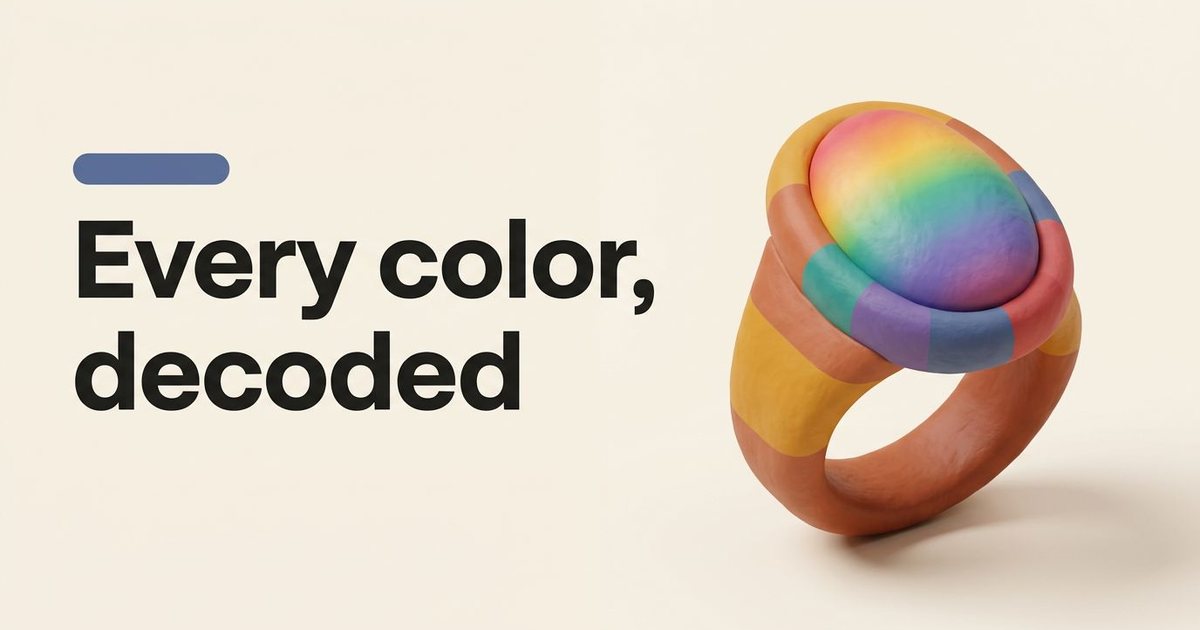
Mood ring colors are a map of your skin temperature dressed up as a map of your feelings. Warm, relaxed fingers turn the stone green, blue, or purple, the shades charts read as calm and content, while cooler fingers, often a side effect of stress, pull it toward amber, gray, and black, the colors tied to tension.
Mood rings are a fun and popular 70s-inspired jewelry item, and half the fun is knowing how to read one. Here is the full chart, then every color decoded, shade by shade.
The Full Mood Ring Color Chart
| Color | Common meaning | What is actually happening | |
|---|---|---|---|
| Black | Stressed, tense, overworked | Coolest reading: blood has pulled away from the skin, or the crystals have stopped responding | |
| Gray | Anxious, drained, on edge | Cool skin with reduced circulation, one step warmer than black | |
| White | Confused or bored, depending on the chart | The crystals are reflecting little visible color, usually at the cool end of the scale | |
| Brown | Restless, jittery, unsettled | Cool fingers just beginning to warm toward baseline | |
| Amber / Gold | Unsettled, mixed emotions | Slightly cool skin, a notch below your normal resting temperature | |
| Yellow | Alert, imaginative, wheels turning | Just below baseline temperature, fingers warming up | |
| Orange | Excited, daring, a little bold | A little below your average finger temperature | |
| Pink | Warm, affectionate, open-hearted | Flushed, well-circulated skin, near the warm end on most charts | |
| Red | Intense, passionate or agitated | Cooler than baseline, despite the fiery reputation | |
| Green | Calm, steady, your baseline | Average finger temperature, roughly 82 to 91 degrees F, the calibrated middle | |
| Blue-Green | Relaxed and open, inwardly at ease | Slightly above your baseline temperature | |
| Blue | At ease, content, comfortable | Warm fingers with good circulation | |
| Dark Blue | Deeply relaxed, genuinely happy | Very warm skin, blood flowing freely to the fingertips | |
| Purple | Romantic, clear-minded, in flow | The warmest reading most rings can show |
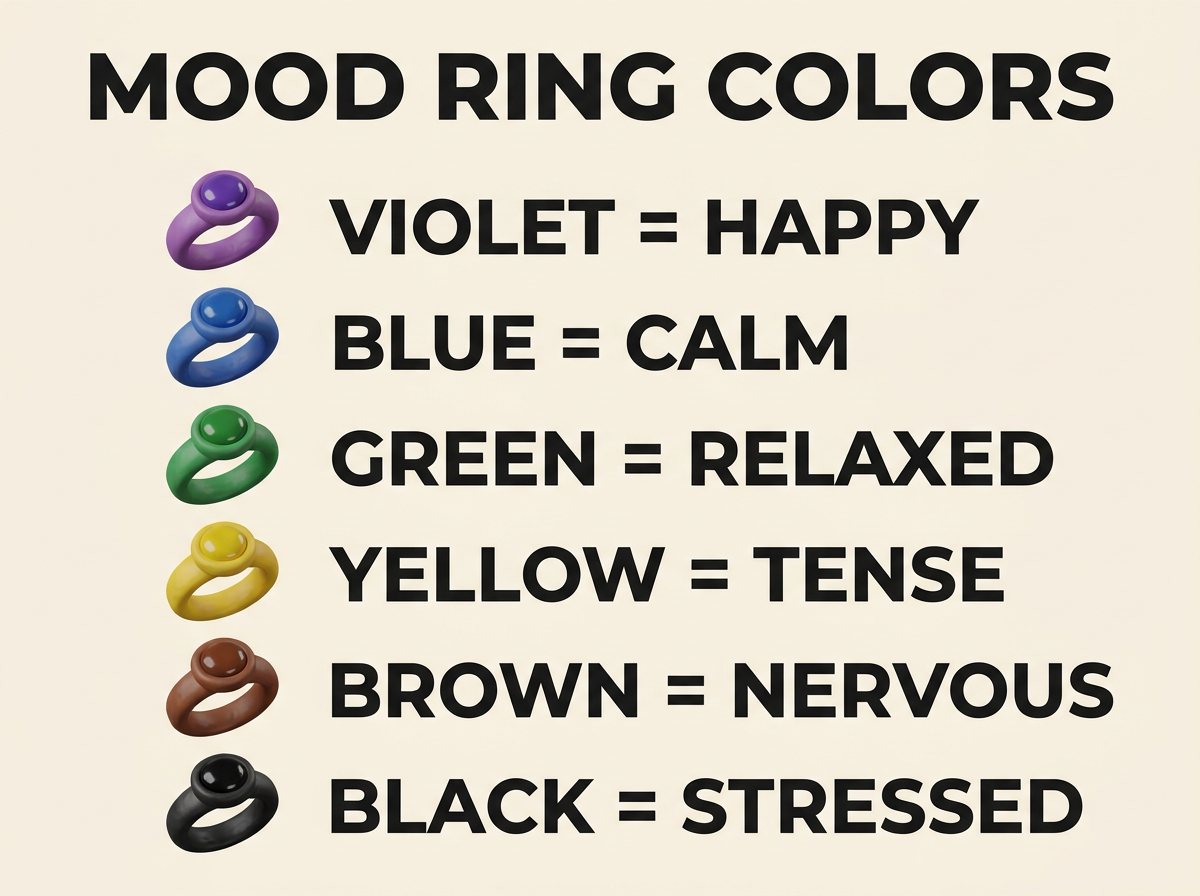
The Cool Colors: Green Through Purple
These are the colors everyone hopes for. On a mood ring, the cool end of the spectrum is actually the warm end of your skin, a charming bit of backwardness we will explain below.
What does green mean on a mood ring?
Green is home base. Most manufacturers calibrate their rings so that ordinary, resting finger temperature lands squarely in green, which is why your ring probably spends most of its life here. The traditional reading is calm: not thrilled, not troubled, just going about your day in a steady, balanced state. Think of green as the ring saying nothing much to report, which, honestly, is a pretty good place to be most afternoons.
What does blue-green mean on a mood ring?
Blue-green, sometimes labeled teal or turquoise on older charts, sits one comfortable step above green. The classic meaning is relaxed and open: you are at ease with yourself and inclined to be easygoing with everyone else. Some 70s charts called this the sociable color, the shade your ring turned at a good dinner party. Physically, your fingers have warmed slightly past their everyday baseline, which tends to happen when you are comfortable, unhurried, and somewhere pleasant.
What does blue mean on a mood ring?
Blue is the classic contented reading, the color that made mood rings famous. The traditional meaning is at ease: calm in a warmer, happier register than green, the difference between a quiet afternoon and a genuinely good one. Blue means the liquid crystals are sitting comfortably above baseline temperature, which usually reflects good circulation and a relaxed body. If someone at a sleepover in 1976 flashed you a blue ring, the message was clear: everything here is just fine.
What does dark blue mean on a mood ring?
Dark blue, sometimes printed as royal blue or indigo, is the reading everyone quietly competed for. Charts describe it as deeply relaxed and genuinely happy, the state where your shoulders have dropped and your breath has slowed without you asking either of them to. Your fingertips are notably warm here, with blood flowing freely, which is your body's signature move when it feels truly safe. Dark blue is the mood ring equivalent of a long exhale at the end of a very good day.
What does purple mean on a mood ring?
Purple is the top of the scale and the most coveted color on the chart. Traditional meanings blend two things that rarely get paired: romance and clarity. A purple ring supposedly signals passion with a clear head, feeling deeply and thinking straight at the same time. Physically it means your fingers are as warm as the crystals can register, blood vessels fully open, body fully at ease. If your ring hits purple, enjoy it. It does not happen every day.
The Warm Colors: Yellow Through Red
Here is the great irony of mood rings: the fiery colors appear when your skin is slightly cool. Charts read these shades as energy and intensity, which conveniently doubles as a description of mild stress.
What does amber or gold mean on a mood ring?
Amber is the in-between color, and its traditional meaning matches: unsettled, mixed feelings, a little of this and a little of that. Charts often describe it as nervous anticipation, the shade of waiting for news or working up the nerve to say something. Your fingers are running a notch below their usual temperature, which happens when you are mildly keyed up or simply sitting in a chilly room. Amber is the ring shrugging: something is stirring, but it could go either way.
What does yellow mean on a mood ring?
Yellow gets one of the nicer write-ups on the classic charts: alert, imaginative, mentally busy. It is the color of a mind with too many browser tabs open, in the best possible way. Some vintage charts also listed it as cautious or watchful, which fits the same picture from a different angle. Temperature-wise, yellow means your fingers are just below baseline, often the mark of light mental activation, when your body diverts a little blood from the extremities to fuel a busy brain.
What does orange mean on a mood ring?
Orange is the daredevil of the chart. Traditional meanings include excited, daring, and ready to take a chance, the shade of raising your hand before you fully know the answer. Some charts add a flicker of nervousness to the mix, because excitement and nerves are close cousins chemically. Underneath the poetry, orange means your skin is a little below its average temperature, the classic signature of adrenaline starting to move blood toward your core. Excitement, it turns out, literally cools your hands.
What does pink mean on a mood ring?
Pink is the sweetheart of the spectrum. Charts read it as warm, affectionate, and open-hearted, the color of early crushes and easy laughter. On most rings pink appears near the warm end of the scale, when skin is flushed and circulation generous, which is genuinely what happens when you feel safe and fond of the people around you. If your ring drifts pink around someone you like, the 1970s would say that means something. The 2020s would say your hands are warm. Both can be true.
What does red mean on a mood ring?
Red is the drama of the chart: intense, passionate, possibly agitated. Vintage charts split the difference between love and anger, which says a lot about both. The honest physics is funnier: red actually appears when your fingers are cooler than baseline, the same circulation shift that comes with strong emotion of any flavor. A pounding heart pulls blood toward your muscles and away from your hands, so fury and infatuation can produce the exact same shade. The ring knows something is happening. It has no idea what.
The Dark and Neutral Shades
The bottom of the scale: the colors of cold hands, long weeks, and, occasionally, a ring that has simply given up.
What does black mean on a mood ring?
Black is the reading nobody wants: stressed, tense, wound tight. It appears when your fingers are at their coolest, because stress pulls blood away from the skin and toward the core. But before you spiral, know the classic caveat: black is also what a dead mood ring looks like. When the thermochromic crystals degrade, from water, heat, or age, they go permanently dark. A black ring means you are either having a hard day or wearing a tired ring, so check it on a warm, relaxed hand before drawing conclusions.
What does gray mean on a mood ring?
Gray is black's quieter sibling: anxious, drained, running on fumes. Charts describe it as low-level strain rather than full alarm, the color of a long commute or a night of bad sleep. Your skin is cool and circulation reduced, but not as dramatically as with black. Gray often shows up as a transition, the ring passing through on its way somewhere warmer or colder. If it lingers, the vintage advice is simple: whatever you are carrying, set it down for a minute.
What does brown mean on a mood ring?
Brown gets read as restless: jittery, fidgety, mind wandering somewhere it does not want to be. Some charts label it nervous anticipation, others just say unsettled. It occupies the awkward zone where your fingers are cool but warming, which is why brown often appears when you first put a ring on or step in from outside. Give it a few minutes on your finger before you take the reading seriously. Half of all brown readings are just a ring getting acquainted with your hand.
What does white mean on a mood ring?
White is the chart's wildcard, and the charts themselves cannot agree on it. Some say confused, some say bored, some say frustrated, which rather proves the confusion point. Physically, white means the liquid crystals are reflecting very little visible color, usually at the cool end of their range. On older rings, a persistent milky white can also be an early sign the crystals are wearing out. If your ring goes white and you feel perfectly clear-headed, trust yourself over the stone.
How Do Mood Rings Change Color?
The stone in a mood ring is not really a stone. It is a hollow shell of glass or quartz filled with thermochromic liquid crystals, rod-shaped molecules arranged in a delicate helix. As temperature changes, the helix twists tighter or looser, changing which wavelength of light the crystals reflect. Cool crystals reflect longer wavelengths, so you see ambers, browns, and near-black. Warm crystals reflect shorter wavelengths, giving you greens, blues, and violets.
Your finger provides the temperature, and your nervous system provides the plot. When you are stressed, your body constricts the small blood vessels in your hands and redirects blood toward your core. Cooler fingertips follow, and the ring slides toward the dark end of the chart. When you relax, those vessels reopen, warm blood returns, and the ring climbs toward blue and purple. That is the entire trick: a thermometer with excellent marketing. For the full science, see how do mood rings work.
Why No Two Mood Ring Charts Agree
If you have ever compared two charts and found that one calls green calm while another calls it jealous, you have discovered the industry's oldest open secret: the meanings were never standardized. There is no governing body of mood rings, no official spectrum. Every manufacturer mixes its own crystal formula, and every formula shifts color at slightly different temperatures.
What manufacturers do share is a calibration target. Rings are tuned so that normal finger skin temperature, roughly 82 to 91 degrees Fahrenheit at the fingertip, lands in the pleasant middle of the range, usually green or blue. That way the average wearer sees a flattering color on an average day, which is simply good business. But one company's green zone is another's blue zone, and the printed meanings were written by whoever was closest to the typewriter. The practical advice: learn your ring's resting color on a calm day, and read everything else relative to that.
Are Mood Ring Colors Accurate?
Time to level with you. A mood ring measures exactly one thing: the temperature of the skin under the stone. That temperature does loosely track with stress, because circulation genuinely shifts when you are anxious or relaxed. So the ring is not lying to you. It is just answering a much smaller question than the one you asked.
The trouble is everything else that moves finger temperature: a cold room, a hot mug, a loose band, the air conditioning vent above your desk. Your ring cannot tell heartbreak from an iced coffee. The colors are a fun, occasionally spooky nudge toward noticing how you feel, and that noticing is the valuable part. Own the ring, don't let it own you. Let it start the conversation, then answer the question yourself.
A Very 1970s Origin Story
The mood ring was born in New York in 1975, invented by Joshua Reynolds and Maris Ambats, who bonded liquid crystals to quartz and had the excellent instinct to call the result a mood ring rather than a wearable thermometer. Reynolds pitched it as jewelry that revealed your inner state, and the 70s, freshly obsessed with biofeedback and finding yourself, was ready.
The upscale department store Bonwit Teller started selling them, and the craze detonated. Silver-toned rings went for 45 dollars, gold for 250, real money at the time, and cheap imitations soon flooded every mall in America as a generation learned to check their finger before checking their feelings. The fad cooled, as fads do, but fifty years later the ring still shows up in gift shops and jewelry drawers, still quietly turning blue on good days.
Frequently Asked Questions
What is the most common mood ring color?
Green and blue, by a wide margin. Rings are calibrated so that typical resting finger temperature lands in the green-to-blue band, so that is where a healthy ring on a comfortable hand spends most of its time. If your hands run warm you will live in blue; if they run cool, expect more green and the occasional amber.
Why is my mood ring always green or blue?
Because your ring is working and your body is behaving normally. Green and blue represent the calibrated middle of the temperature range, where ordinary finger skin temperature sits. The ring only leaves that zone when something meaningfully shifts your circulation: real stress, real cold, real warmth. Green or blue is the ring reporting an uneventful, comfortable day.
Why did my mood ring turn permanently black?
The liquid crystals inside have most likely degraded. Water is the classic killer, which is why so many vintage rings died in swimming pools, but heat, humidity, and plain age do it too. Once the crystal structure breaks down, it can no longer twist with temperature, so the stone stays dark no matter how relaxed you are. There is no reviving it, only replacing it.
Do mood rings work in cold weather?
Not really. Cold air chills your fingers directly, so the ring reads gray, amber, or black regardless of your actual mood. You could be having the best day of your winter and the ring will still insist you are tense. For a fair reading, warm your hands indoors for a few minutes first, then look at the stone.
Are all mood ring color charts the same?
No, and they never have been. Meanings were invented by individual manufacturers rather than standardized, so charts disagree freely, especially on white, amber, and yellow. The broad pattern is consistent, with dark shades for cool skin and blues and purples for warm skin, but the labels vary. Your best chart is your own ring: learn its calm-day baseline and read from there.