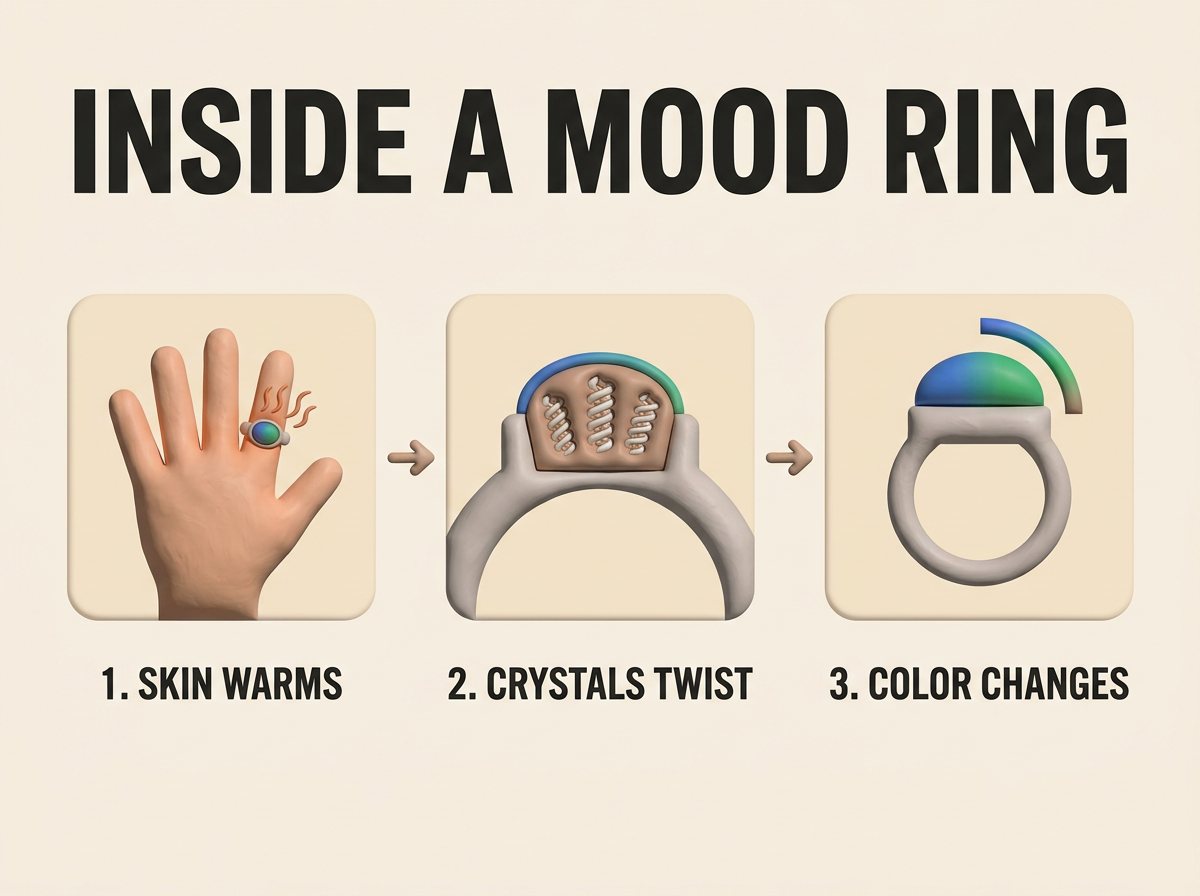
Mood rings work using thermochromic liquid crystals that twist as your skin temperature changes, reflecting different wavelengths of light as different colors. The ring is reading your finger temperature, not your mind. That sounds like a letdown, but stay with it, because the full story is better than the myth. Your finger temperature actually does shift with stress and relaxation, which means a mood ring is a crude but genuine window into what your nervous system is up to. It is a kind of magic with a scientific basis.
The Science: Thermochromic Liquid Crystals
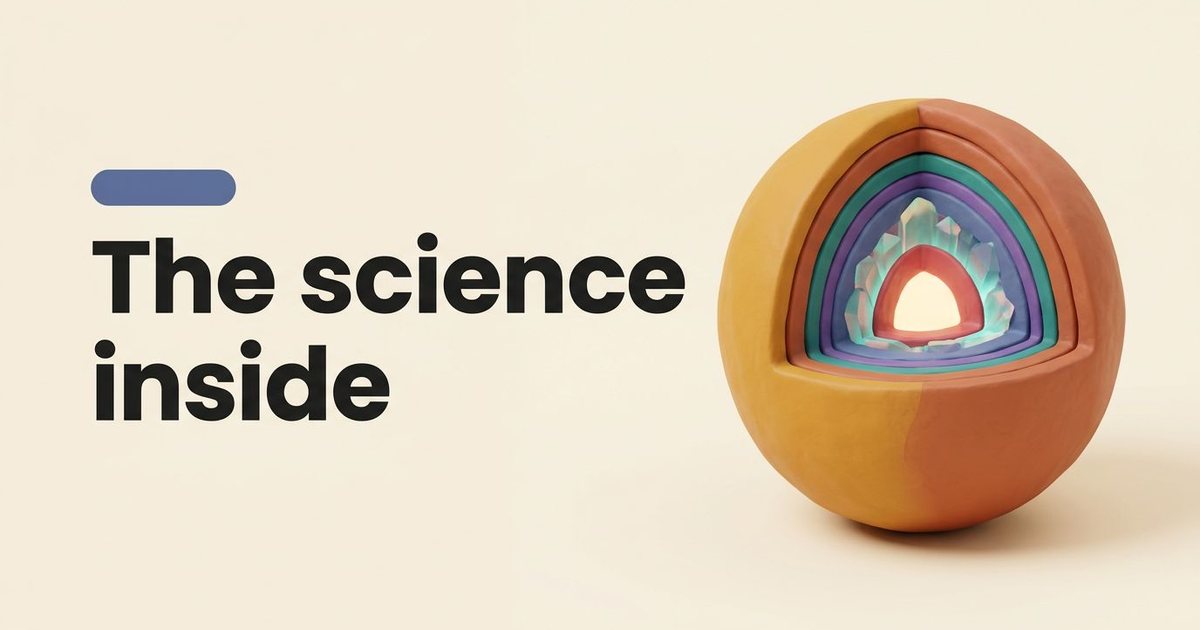
The stone in a mood ring is not a stone at all. It is a hollow shell of glass or quartz filled with thermochromic liquid crystals, the same family of materials used in forehead fever strips and aquarium thermometers. Thermochromic just means color changes with heat, and liquid crystals are strange in-between substances that flow like a liquid but keep some of the orderly structure of a solid.
Inside the ring, the crystal molecules stack in layers that twist into a gentle spiral, like a microscopic spiral staircase. Here is the clever part. The tightness of that twist determines which wavelength of light the crystals reflect back at your eye. Heat the crystals and the molecules gain energy, the spiral tightens, and the structure reflects shorter wavelengths, which read as blue and violet. Cool them down and the spiral relaxes, reflecting longer wavelengths toward red and amber, until eventually the structure scatters so little visible light that the stone looks dark or black.
Manufacturers blend the crystals so that a normal, comfortable finger temperature lands right in the middle of the range, which is why a mood ring on a relaxed hand usually settles on green or blue. Every shade above or below that midpoint is just your skin running slightly warmer or cooler than baseline.
| Ring color | Finger temperature | Common label |
|---|---|---|
| Black | Coolest | Stressed |
| Amber | Cool | Unsettled |
| Green | Baseline | Calm |
| Blue | Warm | Relaxed |
| Purple | Warmest | Very relaxed |
This is the short version of the spectrum. For every shade, blend, and in-between color and what each one is supposed to mean, see our full mood ring colors chart.
The Body Part That Does the Talking: Blood Flow
So the ring reads temperature. The obvious follow-up question is whether temperature has anything to do with mood, and the honest answer is: a little, and in one specific way. The connection runs through your blood vessels.
When you feel stressed or anxious, your sympathetic nervous system kicks into fight-or-flight mode. One of its oldest tricks is vasoconstriction, which means the small blood vessels near the surface of your skin squeeze tight and shunt blood toward your core and major muscles, where your body thinks it will be needed. Less warm blood reaching your fingertips means cooler fingers, and cooler fingers push the ring down the spectrum toward amber and black. This is the same reason your hands go cold and clammy before a big presentation.
Relaxation does the opposite. When your parasympathetic nervous system takes over, those surface vessels dilate, warm blood flows freely back into your hands, your fingertips heat up by a degree or two, and the ring climbs toward blue and purple. That physiological loop is real, measurable, and the entire scientific backbone of the mood ring. The ring is not psychic. It is a tiny thermometer eavesdropping on your circulation.
A Short History of the Mood Ring
The mood ring was born in New York in 1975, invented by Joshua Reynolds and Maris Ambats, who bonded liquid crystals to quartz stones and set them into rings. Reynolds, a marketing mind with an interest in biofeedback, pitched the ring as a piece of jewelry that could make your inner state visible, and the timing was perfect. The mid-1970s were saturated with pop psychology, meditation fads, and a general hunger for self-knowledge you could buy at a department store.
And buy it people did. The ring debuted at Bonwit Teller, the upscale Manhattan department store, and became an instant sensation. A silver version sold for 45 dollars, and a gold version went for 250 dollars, serious money for the era, yet the first production runs sold out in days. Within months, cheaper imitations flooded the market, and the mood ring became one of the defining fads of the decade, sitting comfortably alongside the pet rock in the hall of fame of things America briefly could not live without.
Like all great fads, it never fully died. Mood rings have cycled back into fashion roughly once a decade, riding waves of 90s nostalgia, Y2K revivals, and the modern wellness boom. Each generation rediscovers the same small thrill: glancing down at your hand and wondering what your body knows that you do not.
So, Do Mood Rings Actually Work?
Time for the honest verdict, delivered with love. A mood ring reliably does exactly one thing: it detects changes in the temperature of your skin. At that job, it is genuinely competent. The liquid crystals respond to shifts of a degree or less, and the stress-to-cold-fingers pathway is well documented physiology.
Everything past that point is interpretation. There are zero peer-reviewed studies validating mood rings as instruments of emotion detection, and no evidence that specific colors map to specific feelings. The color chart that ships with every ring was written by marketers, not physiologists. Worse for the ring's case, ambient temperature confounds everything. Step outside on a January morning and your ring will declare you stressed no matter how serene you feel. Hold a hot mug of tea and you are suddenly blissful. A fever, a workout, or a cold office will all out-shout your actual emotional state.
And honestly, that is fine. The mood ring was always jewelry first and instrument second. It is a conversation starter that happens to contain real materials science, a wearable reminder that your body and your feelings are connected. Expecting it to diagnose your inner life is like expecting a lava lamp to forecast the weather. Enjoy it for what it is, and reach for better tools when you want real answers.
Why Mood Rings Die (Turn Permanently Black)
Every mood ring owner eventually faces the same small tragedy: one day the stone goes black and never changes again. This is not a sign of permanent doom in your emotional life. It is crystal degradation, and it has two main causes.
- Water. The liquid crystals are sealed under the clear dome, but the seal is rarely perfect. Wash dishes, take a shower, or get caught in the rain with the ring on, and moisture can creep in. Water disrupts the delicate helical structure of the crystals, and once those spirals collapse they cannot reform. The stone stops reflecting visible light and reads as black, brown, or a murky gray forever.
- Heat. Extreme temperatures do similar damage. A ring left on a sunny dashboard or run through a clothes dryer can cook the crystals past the point where their molecular order survives. High heat permanently scrambles the layers, and the color response dies with them.
There is no repair for a dead mood ring, so prevention is the whole game. Take the ring off before water touches it, store it somewhere cool and dry, and it can keep shifting colors for years. Treat it carelessly and it will spend the rest of its life insisting you are stressed, which feels a little pointed, but is just chemistry.
Frequently Asked Questions
Do mood rings really tell your mood?
Not directly. A mood ring measures the temperature of your skin, which can shift with stress and relaxation because of changes in blood flow to your hands. There is no scientific evidence that a ring can identify specific emotions, but the temperature changes it displays are real.
Why does my mood ring stay one color?
Usually because your finger temperature is sitting in one stable range, which is normal. If the ring never changes at all, even after warming your hands or coming in from the cold, the liquid crystals may have degraded from water or heat exposure and the ring has stopped responding.
Can a mood ring work in cold weather?
Not reliably. Cold air chills your fingers no matter how you feel, so the ring will read dark colors like black or amber even if you are perfectly calm. Mood rings are calibrated for comfortable indoor temperatures, roughly room temperature, where your baseline skin heat can dominate the reading.
How is a mood ring calibrated?
Manufacturers blend the liquid crystals so that average resting finger temperature, around 82 to 90 degrees Fahrenheit at the skin surface, lands in the middle of the color range, usually green or blue. Cooler skin shifts the crystals toward amber and black, and warmer skin shifts them toward blue and purple.
Can you fix a mood ring that turned black?
Unfortunately, no. A mood ring that stays black has usually suffered permanent damage to its liquid crystals, most often from water getting under the seal or from high heat. Once the crystal structure breaks down it cannot reform, so the only fix is a replacement ring.