The Complete Feelings List (Quick Reference)
A feelings list is a vocabulary of emotion words organized so you can find the one that matches what you actually feel. This list contains 250+ feeling words grouped under 6 core emotions and 34 sub-feelings, with every row ordered from mild to intense, so you can name not just the feeling but how strong it is.
Skim the six tables below to find your word fast. The rest of this guide walks through each feeling in depth, with definitions and examples of what each one sounds like when you say it out loud.
Joy
| Sub-feeling | Related words (mild to intense) |
|---|---|
| Content | at ease, settled, satisfied, comfortable, mellow, pleased, fulfilled |
| Happy | glad, sunny, lighthearted, upbeat, delighted, joyful, jubilant |
| Cheerful | bright, chipper, playful, perky, merry, bubbly, gleeful |
| Proud | capable, accomplished, confident, self-assured, dignified, triumphant, victorious |
| Optimistic | hopeful, encouraged, expectant, positive, eager, inspired, buoyant |
| Enthusiastic | curious, interested, engaged, animated, excited, pumped, exhilarated |
| Elation | uplifted, elevated, radiant, blissful, euphoric, ecstatic, on top of the world |
| Enthralled | intrigued, absorbed, captivated, fascinated, enchanted, spellbound, awestruck |
Love
| Sub-feeling | Related words (mild to intense) |
|---|---|
| Affectionate | warm, fond, caring, friendly, close, adoring, devoted |
| Longing | wistful, nostalgic, missing someone, yearning, pining, homesick, lovesick |
| Desire | drawn, attracted, flirtatious, craving, passionate, infatuated, smitten |
| Tenderness | soft, gentle, touched, warmhearted, compassionate, nurturing, protective |
| Peaceful | calm, relaxed, soothed, safe, secure, serene, tranquil |
Surprise
| Sub-feeling | Related words (mild to intense) |
|---|---|
| Stunned | startled, taken aback, shocked, rattled, shaken, stupefied, speechless |
| Confused | uncertain, puzzled, perplexed, disoriented, baffled, bewildered, lost |
| Amazed | impressed, wowed, astonished, astounded, in awe, dazzled, flabbergasted |
| Overcome | swept up, flooded, overwhelmed, swamped, engulfed, floored, undone |
| Moved | stirred, affected, warmed, softened, humbled, choked up, brought to tears |
Fear
| Sub-feeling | Related words (mild to intense) |
|---|---|
| Scared | uneasy, wary, alarmed, frightened, afraid, spooked, petrified |
| Terror | threatened, filled with dread, panicky, frantic, terrified, hysterical, paralyzed |
| Insecure | self-conscious, doubtful, inadequate, exposed, vulnerable, inferior, worthless |
| Nervous | on edge, restless, jittery, tense, worried, anxious, apprehensive |
| Horror | disturbed, unnerved, aghast, appalled, horrified, mortified, traumatized |
Sadness
| Sub-feeling | Related words (mild to intense) |
|---|---|
| Suffering | hurting, aching, pained, wounded, anguished, agonized, tormented |
| Despondent | down, blue, low, glum, gloomy, dejected, defeated |
| Disappointed | let down, disheartened, displeased, dismayed, discouraged, disillusioned, crushed |
| Shameful | sheepish, embarrassed, flustered, regretful, remorseful, guilty, humiliated |
| Neglected | left out, overlooked, unimportant, unwanted, isolated, abandoned, rejected |
| Despair | weary, drained, helpless, powerless, hopeless, grief-stricken, heartbroken |
Anger
| Sub-feeling | Related words (mild to intense) |
|---|---|
| Rage | heated, incensed, fuming, livid, furious, enraged, seething |
| Exasperated | impatient, frustrated, agitated, aggravated, fed up, at the end of your rope |
| Irritable | annoyed, bothered, cranky, grumpy, irritated, prickly, on a short fuse |
| Envy | comparing, covetous, jealous, resentful, bitter, spiteful, begrudging |
| Disgust | turned off, put off, averse, contemptuous, repelled, revolted, repulsed |
Joy: The Feelings of Lightness
Joy is the family of feelings that tells you something is going well. It shows up as energy, openness, and a pull toward the thing that caused it. People tend to under-name their positive feelings, settling for "good" or "fine" when the real word is more specific and more useful. Joy has range, from the quiet satisfaction of a finished task to the full-body rush of a dream coming true, and naming the exact shade helps you notice what actually makes your life better.
Content
Content is the quiet baseline of joy, the feeling that nothing needs to change right now.
Mild to intense: at ease, settled, satisfied, comfortable, mellow, pleased, fulfilled.
Out loud, it sounds like: "Honestly, I don't need anything to be different right now. This is enough."
Happy
Happy is active pleasure in the present moment, brighter than content and easier to see on your face.
Mild to intense: glad, sunny, lighthearted, upbeat, delighted, joyful, jubilant.
Out loud, it sounds like: "Today just worked. I've been smiling at nothing all afternoon."
Cheerful
Cheerful is happiness with social energy, the version of joy that spills onto other people.
Mild to intense: bright, chipper, playful, perky, merry, bubbly, gleeful.
Out loud, it sounds like: "I keep cracking jokes and I can't help it. Everything feels light today."
Proud
Proud is joy directed at yourself, the feeling of having met your own standard.
Mild to intense: capable, accomplished, confident, self-assured, dignified, triumphant, victorious.
Out loud, it sounds like: "I actually did that. Six months ago I couldn't have, and today I did."
Optimistic
Optimistic is joy pointed at the future, the sense that things are heading somewhere good.
Mild to intense: hopeful, encouraged, expectant, positive, eager, inspired, buoyant.
Out loud, it sounds like: "For the first time in a while, I can picture this working out."
Enthusiastic
Enthusiastic is joy with momentum, energy that wants to be spent on something specific.
Mild to intense: curious, interested, engaged, animated, excited, pumped, exhilarated.
Out loud, it sounds like: "I could not stop talking about it at dinner. I want to start right now."
Elation
Elation is joy at high altitude, the surging feeling when something wonderful actually happens.
Mild to intense: uplifted, elevated, radiant, blissful, euphoric, ecstatic, on top of the world.
Out loud, it sounds like: "I got the call and I just started laughing. I still can't believe it's real."
Enthralled
Enthralled is joy that captures your full attention, the feeling of being completely taken by something.
Mild to intense: intrigued, absorbed, captivated, fascinated, enchanted, spellbound, awestruck.
Out loud, it sounds like: "Three hours went by and I didn't check my phone once. I was completely inside it."
Love: The Feelings of Connection
Love is the family of feelings about attachment, closeness, and care. It is broader than romance. Love covers the warmth you feel toward a friend, the ache of missing someone, the calm of feeling safe with a person, and the fierce softness of wanting to protect someone. Many feelings wheels fold love into joy, but separating it matters, because the feelings of connection behave differently: they are about someone or something outside yourself.
Affectionate
Affectionate is warm attachment, the everyday fondness you feel toward people you are close to.
Mild to intense: warm, fond, caring, friendly, close, adoring, devoted.
Out loud, it sounds like: "I just really like being around her. Even doing nothing together feels good."
Longing
Longing is love across distance, the pull toward someone or something that is not here.
Mild to intense: wistful, nostalgic, missing someone, yearning, pining, homesick, lovesick.
Out loud, it sounds like: "A song came on and suddenly I missed him so much my chest hurt."
Desire
Desire is love with heat, the magnetic wanting of someone or something.
Mild to intense: drawn, attracted, flirtatious, craving, passionate, infatuated, smitten.
Out loud, it sounds like: "I keep finding excuses to text them. I think about it more than I want to admit."
Tenderness
Tenderness is gentle love, the soft, protective care you feel toward someone vulnerable.
Mild to intense: soft, gentle, touched, warmhearted, compassionate, nurturing, protective.
Out loud, it sounds like: "Watching him sleep, I just wanted to make sure nothing hard ever happens to him."
Peaceful
Peaceful is love at rest, the settled feeling of being safe and unguarded with a person, a place, or yourself.
Mild to intense: calm, relaxed, soothed, safe, secure, serene, tranquil.
Out loud, it sounds like: "With her I don't perform. My shoulders drop the second I walk in the door."
Surprise: The Feelings of the Unexpected
Surprise is the family of feelings that fires when reality does not match your prediction. It is the most neutral of the six core emotions, a hinge that can swing toward joy, fear, or sadness within seconds. That is exactly why it deserves its own words. Naming the surprise itself, before it resolves into something else, tells you a lot about what you were expecting and what you assumed, and our feelings are a source of data about exactly those assumptions.
Stunned
Stunned is surprise that stops you, the moment your mind blanks because the news is too big to process.
Mild to intense: startled, taken aback, shocked, rattled, shaken, stupefied, speechless.
Out loud, it sounds like: "When they told me, I just stood there. I could not think of a single word."
Confused
Confused is surprise without resolution, the disoriented feeling of events not adding up.
Mild to intense: uncertain, puzzled, perplexed, disoriented, baffled, bewildered, lost.
Out loud, it sounds like: "I keep replaying the conversation and I still don't understand what changed."
Amazed
Amazed is surprise tilted toward wonder, when the unexpected thing is bigger or better than you imagined.
Mild to intense: impressed, wowed, astonished, astounded, in awe, dazzled, flabbergasted.
Out loud, it sounds like: "I knew it would be good, but I was not prepared for that. I actually gasped."
Overcome
Overcome is surprise by volume, when there is suddenly more feeling than you can hold at once.
Mild to intense: swept up, flooded, overwhelmed, swamped, engulfed, floored, undone.
Out loud, it sounds like: "It all landed at the same time and I just had to sit down for a minute."
Moved
Moved is surprise of the heart, when something unexpectedly touches you more deeply than the moment seemed to warrant.
Mild to intense: stirred, affected, warmed, softened, humbled, choked up, brought to tears.
Out loud, it sounds like: "It was such a small gesture, and I teared up anyway. It caught me completely off guard."
Fear: The Feelings of Threat
Fear is the family of feelings that protects you. Every fear word points at something you care about that feels at risk: your safety, your standing, your future, your sense of who you are. That is worth remembering, because fear gets dismissed as weakness when it is actually information. The words below range from the low hum of unease to the full alarm of terror, and knowing where you sit on that ladder changes what you should do next.
Scared
Scared is the general alarm, fear with a clear object that your body wants to avoid.
Mild to intense: uneasy, wary, alarmed, frightened, afraid, spooked, petrified.
Out loud, it sounds like: "I don't want to open that email. My stomach drops every time I see it."
Terror
Terror is fear at maximum volume, the overwhelming state where the threat feels immediate and escape feels uncertain.
Mild to intense: threatened, filled with dread, panicky, frantic, terrified, hysterical, paralyzed.
Out loud, it sounds like: "For those few seconds I could not breathe or move. My whole body was screaming."
Insecure
Insecure is fear about your own worth, the shaky sense that you are not enough or that others can see your flaws.
Mild to intense: self-conscious, doubtful, inadequate, exposed, vulnerable, inferior, worthless.
Out loud, it sounds like: "Everyone in that meeting seemed to know what they were doing except me."
Nervous
Nervous is fear about the future, anticipation of something that has not happened yet and might go wrong.
Mild to intense: on edge, restless, jittery, tense, worried, anxious, apprehensive.
Out loud, it sounds like: "The interview is tomorrow and I've rewritten my answers four times tonight."
Horror
Horror is fear mixed with revulsion, the recoil from something that violates your sense of how the world should be.
Mild to intense: disturbed, unnerved, aghast, appalled, horrified, mortified, traumatized.
Out loud, it sounds like: "I read the story and had to put my phone down. I can't stop seeing it."
Sadness: The Feelings of Loss
Sadness is the family of feelings about losing something that mattered: a person, a plan, an image of yourself, a hope. It slows you down on purpose, pulling your attention toward what was lost so you can absorb it. Sadness has the widest range of any emotion family here, from a passing low mood to grief that reorganizes your life, and the vague word "sad" hides that entire spectrum. The words below give it back.
Suffering
Suffering is active emotional pain, the raw hurt of a wound that is still open.
Mild to intense: hurting, aching, pained, wounded, anguished, agonized, tormented.
Out loud, it sounds like: "It physically hurts. I keep waiting for it to dull and it hasn't yet."
Despondent
Despondent is low-energy sadness, the gray, flattened mood where nothing seems worth the effort.
Mild to intense: down, blue, low, glum, gloomy, dejected, defeated.
Out loud, it sounds like: "Nothing is wrong exactly. I just can't get myself to care about anything today."
Disappointed
Disappointed is the sadness of unmet expectations, the gap between what you hoped for and what happened.
Mild to intense: let down, disheartened, displeased, dismayed, discouraged, disillusioned, crushed.
Out loud, it sounds like: "I really believed this one would work out. I let myself hope, and that's the part that stings."
Shameful
Shameful is sadness turned on yourself, the sinking feeling of having fallen short of your own values or been seen falling short.
Mild to intense: sheepish, embarrassed, flustered, regretful, remorseful, guilty, humiliated.
Out loud, it sounds like: "I keep cringing at what I said. I wish I could take that one moment back."
Neglected
Neglected is the sadness of being unseen, the ache of mattering less to someone than they matter to you.
Mild to intense: left out, overlooked, unimportant, unwanted, isolated, abandoned, rejected.
Out loud, it sounds like: "They planned the whole trip and nobody thought to ask me. I found out from a photo."
Despair
Despair is sadness without a visible exit, the heavy conviction that things will not get better.
Mild to intense: weary, drained, helpless, powerless, hopeless, grief-stricken, heartbroken.
Out loud, it sounds like: "I've tried everything I know how to try. I don't see a way through this anymore."
Anger: The Feelings of Crossed Lines
Anger is the family of feelings that fires when something you value is violated: your boundaries, your fairness, your effort, your people. Anger has a bad reputation because of what people do with it, but the feeling itself is a signal, not a crime. Under almost every anger word is a line that got crossed, and naming the specific word tells you which line it was. That is the difference between exploding and addressing the actual problem.
Rage
Rage is hot, high-intensity anger, the surge that makes you want to raise your voice or slam a door.
Mild to intense: heated, incensed, fuming, livid, furious, enraged, seething.
Out loud, it sounds like: "I had to leave the room. If I had stayed one more minute I would have said something I can't unsay."
Exasperated
Exasperated is anger worn down by repetition, the frustration of hitting the same wall again and again.
Mild to intense: impatient, frustrated, agitated, aggravated, fed up, at the end of your rope.
Out loud, it sounds like: "We have had this exact conversation five times. I am so tired of asking."
Irritable
Irritable is low-grade, ambient anger, a short fuse looking for a spark, often fed by stress, hunger, or poor sleep.
Mild to intense: annoyed, bothered, cranky, grumpy, irritated, prickly, on a short fuse.
Out loud, it sounds like: "Everything is bugging me today. The chewing, the notifications, all of it."
Envy
Envy is anger born from comparison, the resentful ache of watching someone else have what you want.
Mild to intense: comparing, covetous, jealous, resentful, bitter, spiteful, begrudging.
Out loud, it sounds like: "I saw his announcement and my first feeling wasn't happiness for him. I hate that, but it's true."
Disgust
Disgust is moral or visceral rejection, the feeling of wanting distance from something that repels you.
Mild to intense: turned off, put off, averse, contemptuous, repelled, revolted, repulsed.
Out loud, it sounds like: "The way he talked about her made my skin crawl. I don't want to be around that."
What Are the 6 Core Emotions?
The six categories in this list, joy, love, surprise, fear, sadness, and anger, come from a long line of research into which emotions are basic to being human. Psychologist Paul Ekman studied facial expressions across cultures in the 1960s and 70s and found six that people everywhere recognize: happiness, sadness, fear, anger, surprise, and disgust. Psychologist Robert Plutchik later proposed eight primary emotions arranged in opposing pairs, and built his famous emotion wheel around them.
The version used here follows the model behind most modern feelings wheels. It promotes love to its own category, because the feelings of connection deserve more than a corner of joy, and it places disgust within the anger family, where it usually lives in everyday experience. Under those six core emotions sit 34 sub-feelings, and under those sit the individual words.
No model is the final word. Researchers at UC Berkeley have mapped as many as 27 distinct emotion categories, and the true landscape is probably even messier. But a hierarchy of six families is the most practical structure ever built for one specific job: helping a person move from "I feel bad" to the exact word for what is happening inside them. If you want the visual version of this same model, see the feelings wheel guide.
Why Naming Feelings Works
A feelings list is not just a vocabulary exercise. Putting an accurate word on an emotion measurably changes what that emotion does in your brain.
The key research comes from Matthew Lieberman and his colleagues at UCLA. In neuroimaging studies, participants viewed emotionally charged images while researchers watched their amygdala, the brain's alarm system, light up. When participants were asked to label the emotion they were seeing, in plain words, amygdala activity dropped, and activity rose in the prefrontal regions that handle language and regulation. The researchers called this affect labeling. Therapists call it "name it to tame it." Either way, the finding is the same: the act of naming a feeling turns down its intensity.
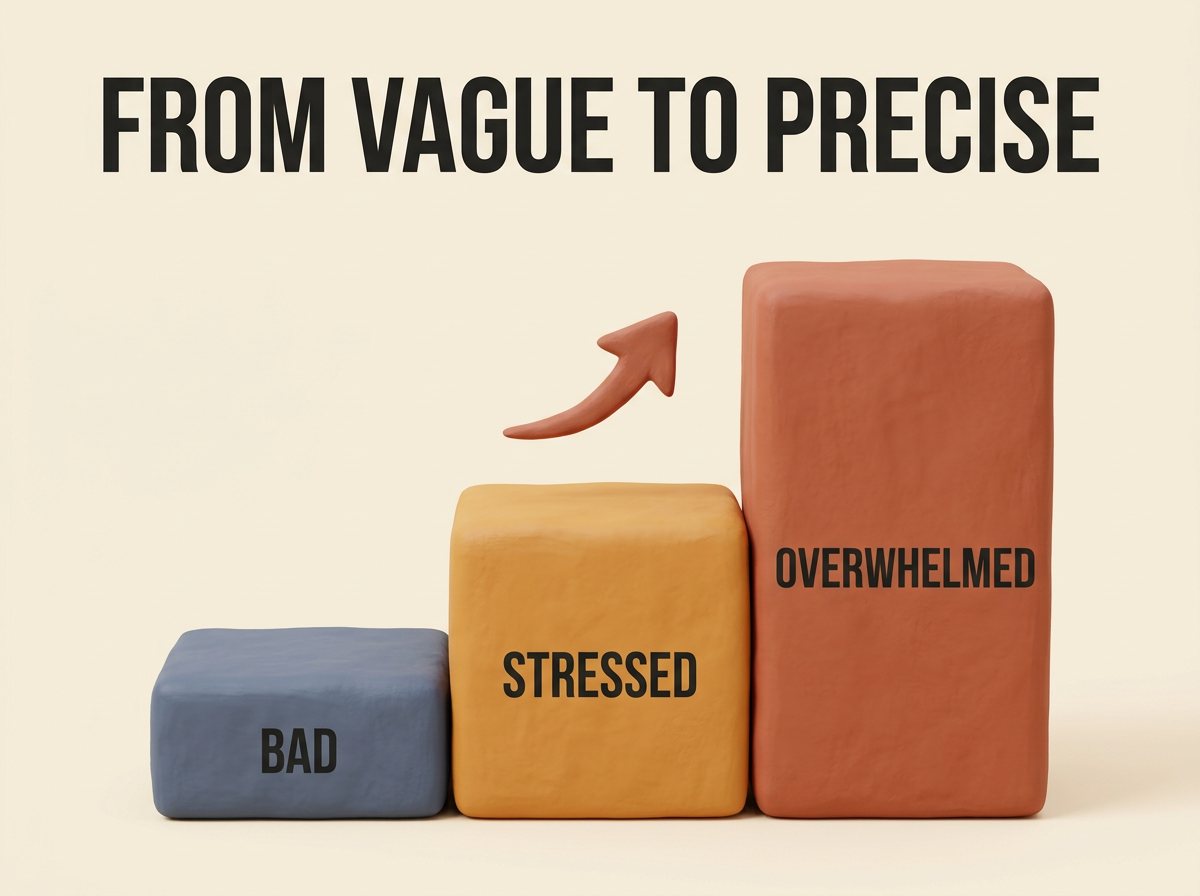
Precision matters here. Psychologists call the skill of making fine distinctions between feelings emotional granularity, and people with higher granularity tend to regulate their emotions better, drink less under stress, and recover faster from hard moments. "Upset" does almost nothing for you. "Humiliated" or "resentful" or "disillusioned" gives your brain something specific to work with, and gives you a specific problem to solve.
This is the entire case for keeping a list like this nearby. When you can accurately name what you feel, you gain the power to address those feelings constructively. The word is not the end of the process. It is the handle that lets you pick the feeling up.
Feelings vs. Judgments
Here is a trap almost everyone falls into: saying "I feel" and then naming something that is not a feeling at all.
"I feel attacked." "I feel ignored." "I feel disrespected." "I feel manipulated." None of these are feelings. They are judgments about what another person did, wearing a feeling's clothing. "Attacked" describes their behavior, or your interpretation of it. The actual feeling underneath might be hurt, scared, embarrassed, or furious.
The distinction matters for two reasons. First, judgments keep your attention on the other person, where you have no control, while feelings return your attention to your own experience, where you do. Second, judgments escalate conflict and feelings defuse it. Tell someone "I feel attacked" and they will defend themselves, because you just described them. Tell them "I felt hurt and a little humiliated" and there is nothing to defend, only something to understand.
A quick test: if the word implies someone did something to you, it is a judgment. Attacked, dismissed, betrayed, abandoned, used, ignored, all of these assign an actor. True feeling words, the kind on this list, describe your inner state without accusing anyone. When you catch yourself saying "I feel [judgment]," pause and ask, "and what does that leave me feeling?" The answer is almost always on one of the six tables above.
How to Use a Feelings List Every Day
A feelings list only works if you actually reach for it, and the best way to make that happen is a small daily ritual. Here is one that takes about two minutes.
- Start with your body. Before you look at any words, scan for physical signals: a tight jaw, a heavy chest, buzzing energy, a pit in your stomach. Your body registers emotion before your vocabulary does, and our feelings are a source of data worth reading.
- Pick the family. Ask which of the six core emotions is closest. Do not overthink it. Wrong guesses are fine; you will feel the mismatch and correct.
- Walk the ladder. Find the sub-feeling, then slide along the mild-to-intense row until a word clicks. "Irritated" and "seething" call for very different responses, so the intensity is half the information.
- Say the sentence out loud. "I feel discouraged about the job search." Speaking the label engages the same affect labeling effect the UCLA research measured. A written note works; a spoken one works better for most people, because speech forces you to finish the thought.
Do this once a day, at the same anchor point, such as the commute home, the kettle boiling, or right before bed. Within a couple of weeks the ladder starts living in your head, and you will find yourself reaching for "disheartened" or "wistful" in the moment, without the list in front of you. That is the goal. The paper is the training wheels; the vocabulary is the skill. If you want to see your patterns over time, pair the ritual with a simple tracking habit, like the one in our guide to how to track emotions.
Frequently Asked Questions
How many emotions are there?
There is no single agreed number. Paul Ekman identified 6 basic emotions with universal facial expressions, Robert Plutchik proposed 8 primary emotions, and more recent research from UC Berkeley mapped 27 distinct emotional categories. Most practical tools, including this list, organize hundreds of feeling words under a small set of core emotions, because that structure is the easiest to actually use when you are trying to name what you feel.
What are the 6 basic emotions?
The 6 basic emotions most commonly cited are joy, love, surprise, fear, sadness, and anger. Ekman's original research named happiness, sadness, fear, anger, surprise, and disgust. This list uses the six-emotion model found on most feelings wheels because it separates love from joy, which makes everyday feelings of connection much easier to place.
What is the difference between feelings and emotions?
An emotion is the automatic, physiological response your body produces, such as a racing heart, a flushed face, or a tight chest. A feeling is your conscious experience and interpretation of that response, the part you can name and describe. Emotions happen to you; feelings are how you make sense of them. A feelings list works on the feeling layer, giving you language for what your body already started.
What is the strongest human emotion?
There is no scientifically crowned strongest emotion, but fear and love are the most common answers. Fear is the most physiologically commanding, because it can override nearly everything else in seconds when survival is at stake. Love is the most motivating over long stretches of time. Intensity also varies enormously within each emotion, which is exactly why every row on this list is ordered from mild to intense.
How do I figure out what I am feeling?
Start with your body, not your vocabulary. Notice physical signals like a tight jaw, a heavy chest, or restless energy, then ask which of the 6 core emotions is closest. From there, narrow to a sub-feeling and pick the word on the intensity ladder that matches how strong it is. Saying it out loud, even for two minutes, makes the label more accurate and the feeling easier to work with. When you can accurately name what you feel, you gain the power to address those feelings constructively.