A feelings chart is a simple visual tool that lays out emotions using words, faces, or colors so you can point to exactly what you are feeling. Instead of settling for "fine" or "bad," a chart helps you, or your child, land on the specific word that fits. Below are four free printable charts for every age, plus a plain guide to using them at home, in the classroom, in therapy, or on your own.
Free Printable Feelings Charts
All four charts below are free, download instantly, and require no email address. Click any card, print it, and you are done. They are designed to look good on a fridge, a classroom wall, or a therapy office door.
Feelings Wheel Chart6 core emotions, 34 specific feelings. Color, print-ready.Free PDFFeelings Chart for KidsFriendly faces and simple words for ages 3 to 10.Free PDFFeelings List (Word Chart)250+ emotion words grouped by the 6 core feelings.Free PDFDaily Feelings Check-InA one-page chart for morning or bedtime check-ins.Free PDFNot sure which one to grab? Here is the quick version:
- Feelings Wheel Chart: the best all-purpose pick for teens and adults who want more precise words for what they feel.
- Feelings Chart for Kids: friendly faces and short words, ideal for ages 3 to 10 at home or in early classrooms.
- Feelings List: a deep word bank for writers, therapists, and anyone who wants the full vocabulary.
- Daily Feelings Check-In: a one-page routine sheet for families and classrooms that want a consistent daily habit.
What Is a Feelings Chart?
A feelings chart displays a set of emotions in a visual layout, most often a grid of faces, a color-coded wheel, or a grouped word list. The point is to make emotions easy to find and easy to name. When a feeling is right in front of you as a word or a face, you do not have to generate it from scratch in the middle of a hard moment.
One of the best life skills anyone can develop, at any age, is recognizing and naming their own emotions. Psychologists call this affect labeling, and the research on it is striking. Brain imaging studies at UCLA found that simply putting a feeling into words calms the amygdala, the brain's alarm system, and hands control back to the thinking part of the brain.
In plain terms: naming a feeling shrinks it to a manageable size. A child who can say "I feel left out" instead of melting down, or an adult who can say "I am not angry, I am disappointed," has already started to regulate the emotion. A feelings chart is the cheapest, simplest tool ever invented for making that happen.
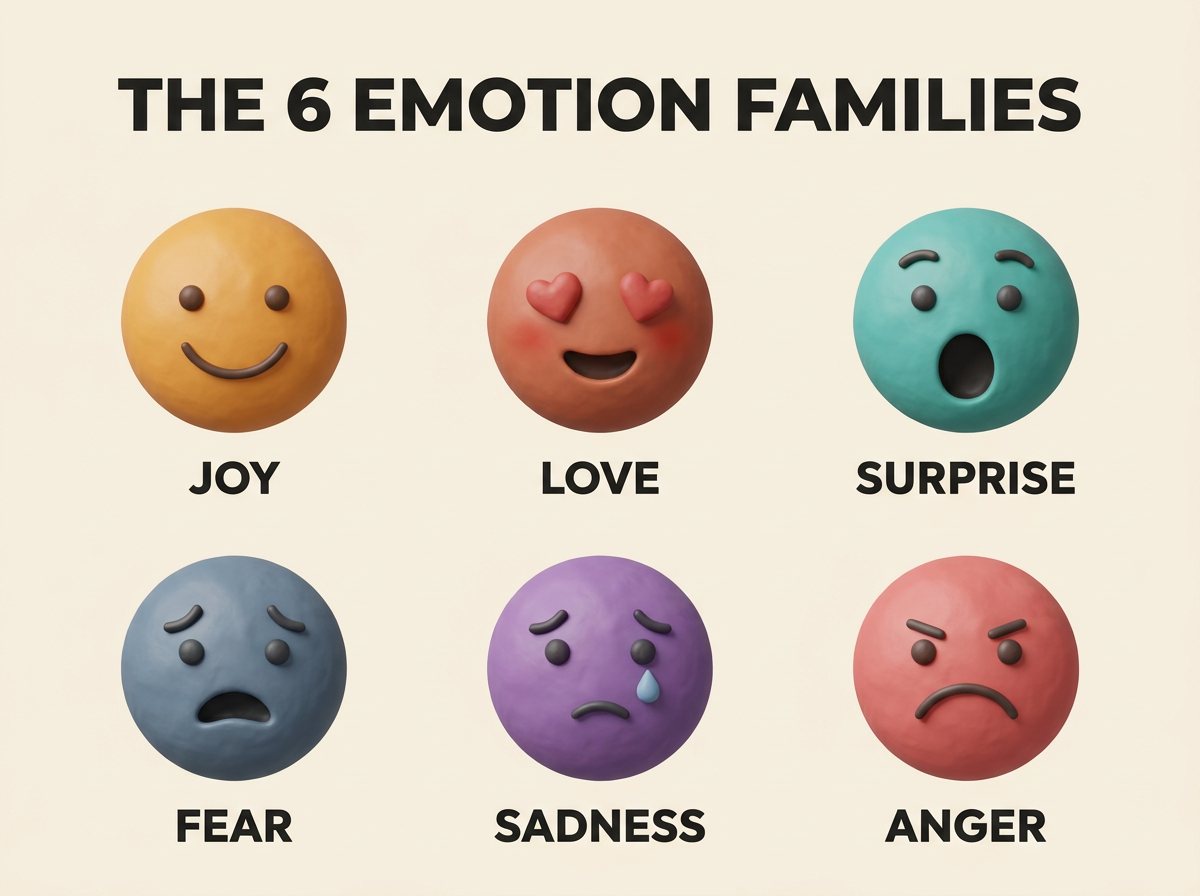
The 6 Core Emotions on Every Good Chart
Every chart on this page is built on the same six core emotions, a structure with deep roots in emotion classification research. Each one branches into more specific feelings, and knowing the branches is where the real skill develops. Here is what lives inside each of the six.
Joy
Joy is the bright family: feeling content, happy, cheerful, proud, optimistic, or enthusiastic. At its strongest it becomes elation or being completely enthralled by a moment. Kids often only know "happy," so a chart helps them notice the difference between quietly content and bouncing-off-the-walls excited.
Love
Love covers connection in all its forms: feeling affectionate, tender, or peaceful, but also longing and desire. It is the emotion most charts leave out entirely, which is a shame. A child who can say "I miss Grandma" is naming longing, and that is love doing its work.
Surprise
Surprise is the fastest emotion, the jolt before you know whether something is good or bad. It ranges from stunned and confused to amazed, overcome, or deeply moved. Confusion belongs here too, which surprises people: feeling confused is often just surprise that has not resolved yet.
Fear
Fear runs from everyday nervous and insecure feelings up through scared, and at the extreme end, terror and horror. Most of what shows up in daily life is the mild end: nerves before a test, insecurity before a hard conversation. Naming it at the mild end keeps it from growing.
Sadness
Sadness is the largest family for most people. It includes feeling disappointed, neglected, or shameful, along with deeper states like suffering, despondency, and despair. The distinctions matter: disappointed points to an unmet hope, while neglected points to a relationship, and each asks for a different response.
Anger
Anger includes irritable and exasperated on the everyday end, and rage on the far end. Envy and disgust live here too, which explains a lot: the flash of resentment at someone else's good news is anger wearing a disguise. Kids especially need help seeing that anger usually sits on top of another feeling, often fear or sadness.
How to Use a Feelings Chart
A chart on the wall does nothing by itself. The magic is in the small, repeated habit of actually pointing at it. Here is how that habit looks in four different settings.
With kids at home
Hang the kids chart somewhere your child passes every day, like the fridge or their bedroom door. Build one tiny ritual around it: at dinner or bedtime, everyone points to their feeling and says one sentence about it. Parents go first, because kids learn emotional vocabulary by watching adults use it.
Use the chart in calm moments, not just meltdowns. If it only comes out when things go wrong, it starts to feel like a consequence. And when your child does name a hard feeling, resist the urge to fix it immediately. "That makes sense" is often the whole job.
In the classroom
Many teachers post a feelings chart by the door and have students tap or point to their feeling as they walk in. It takes ten seconds and tells you more about your room than a whole morning of observation. A quiet student pointing at "nervous" before a presentation is a student you can actually help.
The Daily Feelings Check-In sheet works well as a morning routine for younger grades. For older students, the full feelings wheel makes a strong writing prompt: pick a word from the outer ring and describe the last time you felt it.
In therapy
Therapists and counselors use feelings charts because "how are you feeling" is genuinely a hard question, especially for kids and for adults who grew up without much emotional vocabulary. Handing someone a chart turns an open-ended question into a multiple-choice one, and answers start flowing.
The feelings list is popular in session work because clients can scan a group of words and circle the ones that land. Print a fresh copy each week and the circled words become a record of the work over time.
For yourself
Adults need feelings charts too, maybe more than anyone. Most of us run on about five default words: fine, stressed, tired, busy, and annoyed. A chart pushes past those defaults. The next time your mood is off, scan the wheel and find the word that actually fits, like insecure, exasperated, or despondent.
Pair the chart with a daily check-in, even one minute long. Naming your feeling once a day builds the same skill in adults that the fridge chart builds in kids: emotions become information instead of weather.
Feelings Chart vs. Feelings Wheel: What Is the Difference?
The terms get used interchangeably, but there is a real difference. A feelings chart is the umbrella term for any visual layout of emotions: face grids, word lists, posters, color scales. A feelings wheel is one specific kind of chart, a circle with core emotions at the center and increasingly precise feelings radiating outward.
| Feelings chart | Feelings wheel | |
|---|---|---|
| Shape | Grid, list, or poster | Circle with rings |
| Best for | Quick recognition, young kids | Finding precise words, teens and adults |
| How it works | Scan and pick a feeling | Start at the center, move outward to a specific word |
| Depth | Usually 8 to 30 feelings | Often 30 to 130+ feelings |
In practice, use both. The face chart wins for a four year old who needs to pick between happy, sad, and mad in the moment. The wheel wins for anyone ready to move from "I feel bad" to "I feel neglected," because that outward movement from vague to specific is the entire skill.
Frequently Asked Questions
What is a feelings chart?
A feelings chart is a visual tool that displays emotions using words, faces, or colors so you can point to what you are feeling instead of struggling to describe it. Charts range from simple face grids for toddlers to detailed emotion wheels with dozens of specific feeling words for teens and adults.
What are the 6 basic emotions?
The six core emotions on most feelings charts are joy, love, surprise, fear, sadness, and anger. Every other feeling word, from proud to nervous to disappointed, is a more specific shade of one of these six.
How do I use a feelings chart with my child?
Hang the chart somewhere visible, then build a short daily habit of asking your child to point to the face or word that matches how they feel. Name your own feelings out loud too, and reach for the chart during calm moments as well as hard ones so it never feels like a punishment tool.
What age are feelings charts for?
Every age. Toddlers and preschoolers do best with face-based charts and a handful of simple words, elementary kids can handle 20 to 30 feeling words, and teens and adults benefit most from detailed charts like a feelings wheel or a full feelings list with hundreds of words.
What is the difference between a feelings chart and a feelings wheel?
A feelings chart is any visual layout of emotions, usually a grid or list. A feelings wheel is a specific type of chart shaped like a circle, with core emotions in the center and more precise feelings radiating outward, which makes it easier to move from a vague mood to an exact word.
Are these charts really free?
Yes. Every PDF on this page is completely free, downloads instantly, and requires no email address or signup. Print as many copies as you like for your home, classroom, or practice.