The Era of Good Feelings was the period in United States history from roughly 1815 to 1825, centered on the presidency of James Monroe (1817 to 1825). It was defined by a surge of national pride after the War of 1812 and by one-party rule, because the Federalist Party had collapsed and left Monroe's Democratic-Republicans with almost no opposition. The name comes from a Boston newspaper headline printed during Monroe's goodwill tour in the summer of 1817.
That is the short answer. The longer answer is more interesting, because the "good feelings" were never as good as the name suggests. This guide covers the key facts, a year-by-year timeline, the reasons the era ended, and the essay angle teachers love to assign: was it really an era of good feelings at all?
Key Facts at a Glance
| Dates | Roughly 1815 to 1825 (some textbooks use 1817 to 1825, matching Monroe's two terms) |
|---|---|
| President | James Monroe, the fifth US president (1817 to 1825) |
| Dominant party | Democratic-Republicans, after the Federalist Party collapsed |
| Who coined the phrase | Benjamin Russell, in the Boston Columbian Centinel, July 12, 1817, after Monroe's goodwill tour stop in Boston |
| Key events | Panic of 1819, Missouri Compromise (1820), Monroe Doctrine (1823), election of 1824 |
| Why it ended | Economic crisis, sectional conflict over slavery, and the "corrupt bargain" election of 1824, which split the party and launched the Second Party System |
Why Was It Called the Era of Good Feelings?
The phrase was born on a presidential road trip. Shortly after his inauguration in March 1817, James Monroe set out on a goodwill tour of the northern states. This was a bold move, because New England had been the heartland of the rival Federalist Party and had bitterly opposed the War of 1812. Some New England Federalists had even flirted with secession at the Hartford Convention of 1814 to 1815, a decision that looked disloyal once the war ended and destroyed the party's national reputation.
Monroe's reception surprised everyone. Instead of hostility, the Virginia Republican was greeted with parades, banquets, and cheering crowds, including in Boston, the old Federalist stronghold. Monroe leaned into the moment, dressing in Revolutionary War era clothing that reminded audiences he had fought under George Washington. The tour felt like proof that the old party warfare was finally over.
On July 12, 1817, Benjamin Russell, editor of the Federalist newspaper the Boston Columbian Centinel, published an article celebrating the visit under the title "Era of Good Feelings." The label captured the national mood: the United States had survived a second war against Britain, the economy was growing, one party dominated politics, and Americans felt a new confidence in their country. Historians later adopted the newspaper's phrase as the name for the whole period.
It is worth remembering that the name was journalism, not analysis. It described how 1817 felt, not how the next eight years would actually go.
Timeline: 1815 to 1825
- 1815: The Treaty of Ghent, ratified in February 1815, officially ends the War of 1812. Combined with Andrew Jackson's dramatic victory at the Battle of New Orleans in January, the war's end sets off a wave of national pride.
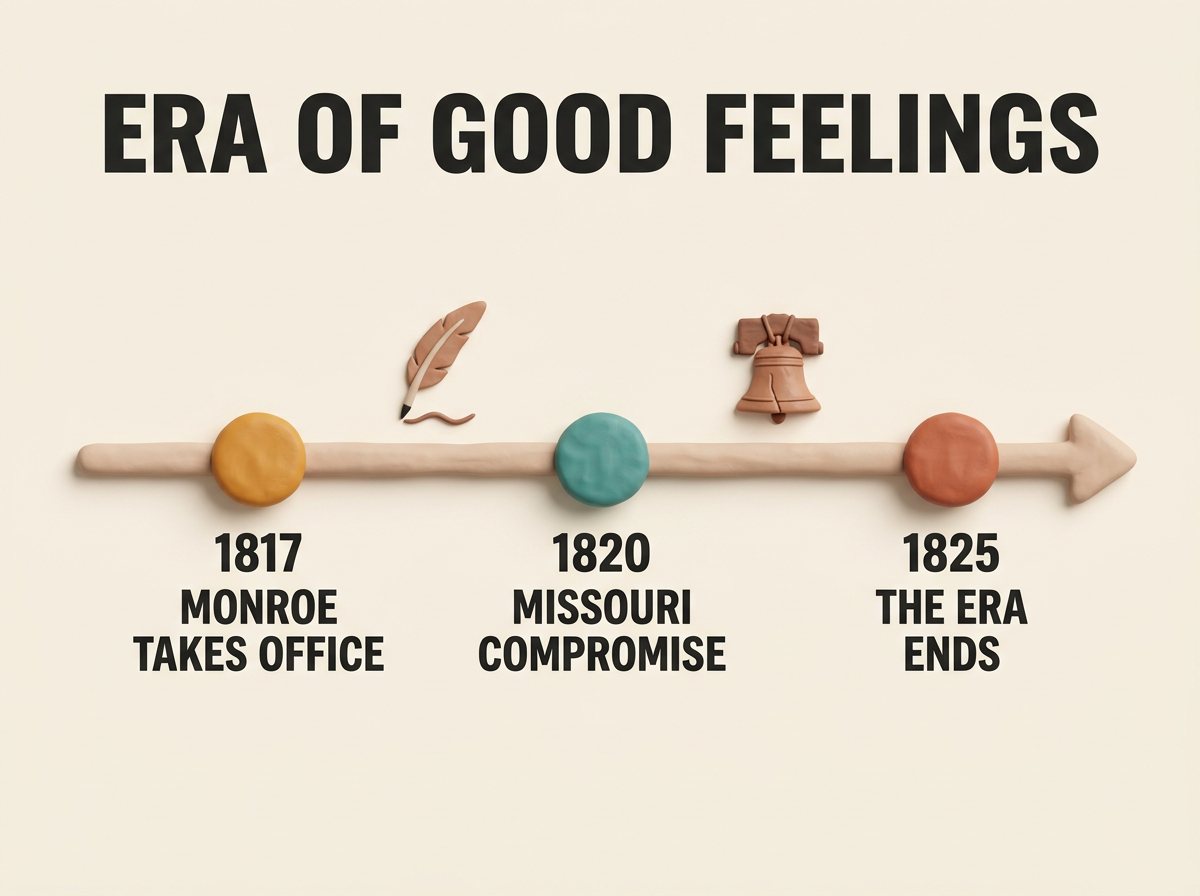
- 1816: Congress charters the Second Bank of the United States and passes the Tariff of 1816, the first tariff designed mainly to protect American manufacturers rather than just raise revenue. James Monroe wins the presidency easily over Rufus King, the last Federalist candidate to run for president.
- 1817: Monroe is inaugurated in March and tours the northern states that summer. On July 12, the Boston Columbian Centinel coins the phrase "Era of Good Feelings."
- 1819: The Panic of 1819 hits, the first major peacetime financial crisis in US history. Land prices collapse, banks fail, and unemployment spreads. Many Americans blame the Second Bank of the United States for tightening credit.
- 1820: The Missouri Compromise admits Maine as a free state and Missouri as a slave state, and bans slavery in the rest of the Louisiana Purchase north of the 36 degrees 30 minutes line. Later that year, Monroe is reelected with every electoral vote except one.
- 1823: In his annual message to Congress, Monroe announces what becomes known as the Monroe Doctrine: the Americas are closed to new European colonization, and the United States will stay out of European affairs. Secretary of State John Quincy Adams shaped much of the policy.
- 1824: Four Democratic-Republicans run for president: Andrew Jackson, John Quincy Adams, William Crawford, and Henry Clay. Jackson wins the most popular and electoral votes, but no one wins a majority, so the House of Representatives decides the election.
- 1825: The House chooses John Quincy Adams, with Henry Clay's support. When Adams then names Clay secretary of state, Jackson's followers denounce a "corrupt bargain." Adams is inaugurated in March 1825, and the Era of Good Feelings is over.
Was It Really an Era of Good Feelings?
This is the question your teacher actually wants you to answer, and most historians answer it with a firm "not really." The label fits the surface of the era, especially its first two years, but underneath the one-party calm the country was splitting along economic, sectional, and personal lines.
The party unity was an illusion
With the Federalists gone, everyone with national ambitions crowded into the Democratic-Republican Party. That did not end political conflict; it just moved the conflict inside the party. Rivals like John Quincy Adams, Andrew Jackson, Henry Clay, William Crawford, and John C. Calhoun spent the era building personal followings and maneuvering for the presidency. A one-party system with five would-be presidents is not unity. It is a waiting room for a political explosion, and the explosion arrived in 1824.
Slavery divided the country
The fight over admitting Missouri as a slave state in 1819 and 1820 showed how deep the sectional divide had become. Northern congressmen tried to restrict slavery in Missouri; Southern congressmen saw that as an attack on their entire system. The Missouri Compromise papered over the dispute, but it alarmed the founding generation. Thomas Jefferson wrote that the Missouri question terrified him "like a fire bell in the night," and that he considered it "the knell of the Union." That is not the language of an era of good feelings.
The economy collapsed
The Panic of 1819 wiped out much of the postwar prosperity that had created the good feelings in the first place. Farmers who had bought land on credit lost everything when prices fell, banks called in loans and then failed, and city workers faced widespread unemployment. The crisis bred lasting resentment toward banks, especially the Second Bank of the United States, and that resentment would fuel Jacksonian politics for the next two decades.
A strong essay thesis usually splits the difference: the era featured genuine nationalism and one-party dominance, so the label is partly accurate, but the Panic of 1819, the Missouri crisis, and factional rivalry make the name ironic when applied to the period as a whole.
Why Did the Era of Good Feelings End?
No single event killed the era. Instead, four forces built up over several years and finally broke the one-party system apart.
- The aftershocks of the Panic of 1819. The depression lasted into the early 1820s and turned ordinary voters against banks, creditors, and political insiders. Economic anger made national harmony impossible to sustain.
- Sectionalism after the Missouri Compromise. The compromise settled the immediate question of Missouri but established that every new territory could reopen the fight over slavery. North and South increasingly voted as sections rather than as one nation.
- Personal factions inside the party. Without a Federalist enemy to unite them, Democratic-Republicans organized around rival leaders instead of shared principles. By 1824 the party was a collection of competing campaigns.
- The election of 1824 and the corrupt bargain. Jackson won the most votes but lost the presidency when the House picked John Quincy Adams, and Adams then made Henry Clay his secretary of state. Jackson's supporters spent the next four years organizing for revenge, forming what became the Democratic Party, while Adams and Clay's followers evolved into the National Republicans and later the Whigs. This new two-party rivalry, the Second Party System, formally ended the one-party era.
By Adams's inauguration in March 1825, American politics was more openly combative than it had been in a decade. The era named for good feelings ended in accusations of theft and betrayal.
Era of Good Feelings for APUSH: Quick Review
The era sits in APUSH Period 4 (1800 to 1848). Exam questions usually test either the irony of the label or the causes of rising sectionalism. Make sure you can define and connect these terms.
- American System: Henry Clay's economic program of a protective tariff, a national bank, and federally funded internal improvements such as roads and canals, meant to bind the nation's regions together.
- Panic of 1819: The first major peacetime financial crisis, caused by collapsing land prices and credit contraction. It undermined postwar prosperity and stoked hostility toward the Second Bank of the United States.
- Missouri Compromise (1820): Maine admitted free, Missouri admitted slave, and slavery banned in the remaining Louisiana Purchase territory north of 36 degrees 30 minutes. It kept the Senate balanced but revealed the depth of sectional conflict.
- Monroe Doctrine (1823): Monroe's declaration that the Western Hemisphere was closed to new European colonization, a landmark statement of American nationalism in foreign policy.
- Corrupt Bargain (1824 to 1825): Jackson's label for the House election of John Quincy Adams and Adams's appointment of Henry Clay as secretary of state. It destroyed party unity and energized Jackson's 1828 campaign.
- Collapse of the First Party System: The Federalists' disappearance after the Hartford Convention left one national party, which created the era's surface unity and guaranteed that new divisions would form inside the Democratic-Republican Party.
Sample short-answer question
Question: Briefly explain ONE way the label "Era of Good Feelings" accurately describes the period 1815 to 1825, and ONE way the label is misleading.
Model answer: The label is accurate in that the period saw strong national unity in politics: the Federalist Party collapsed after the Hartford Convention, James Monroe faced almost no opposition and won reelection in 1820 with all but one electoral vote, and postwar nationalism produced confident policies like the Monroe Doctrine. The label is misleading because serious conflicts ran beneath the surface. The Panic of 1819 caused widespread economic suffering and resentment of the national bank, and the Missouri crisis of 1819 to 1820 exposed a deep sectional divide over slavery that Jefferson compared to "a fire bell in the night." Political unity also proved hollow when the Democratic-Republicans fractured into rival factions in the election of 1824.
Frequently Asked Questions
Who coined the phrase Era of Good Feelings?
Benjamin Russell, editor of the Boston Columbian Centinel, coined it in a July 12, 1817 article after President Monroe's warm reception in Boston during his New England goodwill tour. The fact that a Federalist newspaper celebrated a Republican president was itself evidence of the new mood.
Why is the Era of Good Feelings considered ironic?
Because the harmony was thin. The same decade produced the Panic of 1819, the fierce Missouri debate over slavery, and constant rivalry among Democratic-Republican leaders. Many historians treat the name as an accurate description of 1817 and a misleading description of the era as a whole, which is exactly the tension most essay prompts ask you to explore.
What ended the Era of Good Feelings?
The election of 1824 is the usual endpoint. Four candidates from the same party split the vote, the House chose John Quincy Adams over the more popular Andrew Jackson, and the "corrupt bargain" accusation shattered the Democratic-Republicans. Longer-term causes include the Panic of 1819 and the sectionalism revealed by the Missouri Compromise.
Was James Monroe reelected unanimously?
No, though he came remarkably close. In 1820 Monroe won every electoral vote except one: William Plumer of New Hampshire voted for John Quincy Adams. A famous legend claims Plumer defected so that George Washington would remain the only president elected unanimously, but historians question that story. Plumer's own explanation was blunter: he thought Monroe had managed the government poorly and did not deserve his vote.
What is the only era in US history named after a feeling?
This one. Other periods are named for wars, presidents, or movements, but the Era of Good Feelings is named for a national emotion, which says a lot about how powerfully a shared mood can shape history. That is also why this guide lives in our library about feelings: if a single emotion can label a decade of American politics, it is worth learning how feelings work everywhere else too.