The Core Difference
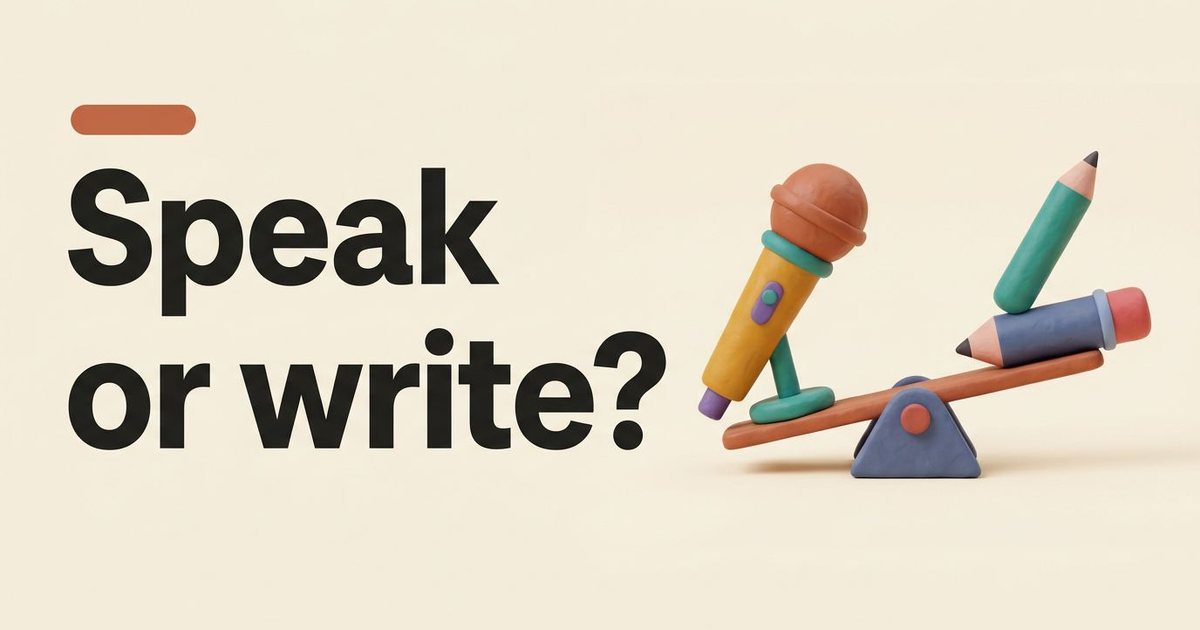
Journaling has taken many forms throughout history, from leather-bound diaries to smartphone notes. But today, the choice many people face is straightforward: should you speak your journal entries out loud, or should you write them down? Both approaches qualify as journaling in the truest sense. Both invite you to slow down, turn inward, and process what's happening in your life. The difference lies in the medium, and that medium shapes the experience more than you might expect.
Voice journaling means recording your thoughts aloud, usually into a phone or dedicated app. You press record, talk through whatever is on your mind, and the entry is captured as audio. Some apps, like Puffy, transcribe your recording automatically so you can revisit it in text form later.
Written journaling means putting thoughts on paper or screen. This could be a physical notebook, a word processor, or a notes app. You translate your inner experience into written language, choosing words deliberately as you go.
Both methods are valid forms of self-reflection, and neither is universally superior. The best one depends on your brain, your schedule, and what you're hoping to get out of the practice. This article walks through the strengths of each approach so you can make an informed choice, or discover that a combination of both serves you best.
Side-by-Side Comparison
Before diving into the nuances, here's a quick look at how voice journaling and written journaling stack up across the dimensions that matter most.
| Feature | Voice Journaling | Written Journaling |
|---|---|---|
| Speed | ~150 words/min | ~40 words/min |
| Emotional rawness | High (tone, pauses captured) | Medium (filtered through writing) |
| Accessibility | Great for ADHD, dyslexia | Requires writing comfort |
| Searchability | With AI transcription | Native |
| Privacy | Requires secure storage | Easy to keep private |
| Reflection depth | Immediate, intuitive | Structured, deliberate |
| Setup needed | Recording app or phone | Notebook or text app |
These numbers tell part of the story, but the real differences go deeper than speed and setup. Let's look at when each approach truly shines.
When Voice Journaling Wins
Voice journaling excels in situations where speed, emotional immediacy, and low friction matter most. If you've ever struggled to get started with a written journal, voice journaling may solve problems you didn't realize were blocking you.
Racing Thoughts
When your mind is spinning, writing can feel painfully slow. You think faster than you can type, and by the time you've finished one sentence, the next three thoughts have already evaporated. Speaking captures the full stream of consciousness at a natural pace. Most people speak at roughly 150 words per minute, which is close to the speed of casual thought. That means voice journaling keeps up with your brain in a way that writing simply cannot.
There's another advantage here: speaking is faster than your inner critic can edit. When you write, it's tempting to revise, delete, and second-guess every sentence. When you speak, the words are already out. This quality makes voice journaling especially powerful for people who tend to self-censor in written form.
On the Move
You can voice journal while commuting, walking the dog, or doing household chores. Writing requires you to sit down with a pen or keyboard. For people with busy schedules, the ability to journal during transition moments throughout the day is a genuine advantage. A five-minute voice entry recorded during your morning walk can replace a journaling session you'd otherwise never find time for.
ADHD and Executive Function Challenges
For people with ADHD, the blank page can feel paralyzing. The executive function demands of writing (organizing thoughts, forming sentences, maintaining focus on a single thread) create friction that often leads to abandoning the practice altogether. Voice journaling removes most of those barriers. You just talk. There's no need to worry about spelling, grammar, paragraph structure, or staying on topic. If your mind jumps around, that's fine; the recording captures it all.
Grief, Anger, and Intense Emotion
When you're processing something painful, writing can feel too slow and too distant. The act of translating raw grief into neat sentences can actually suppress the emotion you're trying to release. Speaking allows you to cry, pause, take a breath, and continue. The recording preserves the emotional texture of the moment: the shakiness in your voice, the long silences, the sudden bursts of clarity. These details matter. They're part of the healing process, and they're lost entirely in written form.
Verbal Processors
Some people simply think better out loud. If you're the kind of person who calls a friend to "talk through" a decision, or who mutters to yourself while problem-solving, voice journaling aligns with the way your brain already works. You don't need to learn a new skill or adopt an unfamiliar habit. You just need a recording device and a few minutes of privacy. For a deeper look at how to build this practice, see our complete voice journaling guide.
When Writing Wins
Written journaling has its own set of strengths, and for certain people and contexts, it remains the better choice. Writing engages a different cognitive process, and that difference produces distinct benefits.
Deep Analytical Reflection
Writing forces you to slow down and structure your thoughts. That slowness, which feels like a drawback in moments of emotional intensity, becomes an asset when you want to analyze a situation carefully. The act of choosing words, arranging ideas into paragraphs, and re-reading what you've written creates a feedback loop that deepens understanding. Written journaling is particularly effective for dissecting complex decisions, identifying recurring patterns in your behavior, or working through a problem that requires logical reasoning.
Shared Spaces
If you live with roommates, share an office, or commute on public transit, speaking your private thoughts aloud may not be practical. Writing is silent. You can journal in a coffee shop, at your desk during a break, or in bed next to a sleeping partner without anyone knowing what you're doing. Privacy is built into the medium.
People Who Think Through Writing
Just as some people are verbal processors, others are written processors. If you've always gravitated toward essays, letters, or long text messages as a way of making sense of your experiences, written journaling will feel natural. For these individuals, the physical act of writing (or typing) is itself part of the thinking process, not a bottleneck but a catalyst.
Visual Organization
Writing gives you spatial control over your thoughts. You can create lists, draw diagrams, use bullet points, underline key phrases, and arrange ideas on the page in ways that reveal relationships between them. Some journalers use color coding, headers, and margin notes to build a personal system of meaning. Voice journaling, by its nature, is linear. You can't rearrange what you've said after the fact (though transcription helps bridge this gap).
Long-Form Self-Analysis
If your goal is to produce extended, structured reflections (something closer to personal essays or therapeutic writing exercises), written journaling gives you the tools to do that. You can draft, revise, and refine your thinking across multiple sessions. The written record becomes a living document you can return to and build on, rather than a snapshot of a single moment.
Can You Do Both?
Absolutely. In fact, many people find that combining both methods gives them a richer journaling practice than either one alone.
A common pattern: voice journal in the morning to capture raw feelings and set intentions for the day, then write in the evening to reflect on what happened and analyze how you responded. The morning voice entry is fast, emotional, and unfiltered. The evening writing session is slower, more deliberate, and more analytical. Together, they cover the full spectrum of self-reflection.
Modern tools make this combination even more seamless. Apps like Puffy automatically transcribe your voice entries, which means you get the speed and emotional immediacy of speaking with the searchability and reviewability of text. You speak freely in the moment, then review the written transcript later when you're ready to reflect more deeply. This gives you the best of both worlds without doubling your effort.
You might also find that different life situations call for different methods. Voice journaling during a stressful week when you need to vent quickly; written journaling during a quieter period when you want to explore ideas at length. There's no rule that says you have to pick one and stick with it forever.
The Science Behind Both Methods
The psychological benefits of journaling are well-documented, and they apply to both voice and written forms. James Pennebaker's expressive writing research, conducted over several decades, established that translating emotional experiences into language produces measurable improvements in mental and physical health. His framework, often called expressive disclosure, demonstrates that the act of articulating difficult experiences helps the brain process and integrate them.
What's interesting is that the core mechanism appears to be linguistic expression itself, not the specific medium. Whether you write the words or speak them, the process of converting raw emotion into structured language activates similar psychological benefits. Your brain has to organize chaotic feelings into a coherent narrative, and that organization is where the healing happens.
That said, there are some differences in how each medium engages the brain. Speaking appears to activate more emotional and social brain regions. When you talk, even to yourself, you recruit the neural circuits involved in conversation, empathy, and emotional expression. This may explain why voice journaling often feels more cathartic and emotionally immediate.
Writing, on the other hand, may engage more analytical and executive function regions. The slower pace of writing gives the prefrontal cortex more time to evaluate, organize, and reframe thoughts. This could explain why written journaling is often better for problem-solving and gaining perspective on complex situations.
Neither medium is objectively "better" from a scientific standpoint. They serve different cognitive functions, and the ideal choice depends on what you need in any given moment: emotional release or analytical clarity, speed or depth, intuition or structure.
Making Your Choice
If you're still unsure which approach to try first, here's some practical guidance based on common situations.
Try Voice Journaling If...
- You've attempted written journaling in the past and quit after a few days or weeks. The friction of writing may have been the problem, not your commitment to the practice.
- You have a lot on your mind but struggle to get the first sentence down. Speaking eliminates the blank-page problem entirely.
- You commute, walk, or exercise regularly and want to use that time productively. Voice journaling fits into movement in a way that writing cannot.
- You process emotions by talking them through, whether with friends, therapists, or yourself.
- You have ADHD, dyslexia, or other conditions that make sustained writing difficult.
If any of these resonate, check out our guide on how voice journaling works in practice or browse the best voice journal apps to find a tool that fits your workflow.
Try Writing If...
- You genuinely enjoy the act of writing. If putting pen to paper (or fingers to keyboard) feels satisfying, lean into that.
- You want structured analysis: pro/con lists, goal tracking, or detailed self-examination that benefits from visual organization.
- You journal in environments where speaking aloud isn't practical, such as shared living spaces, offices, or public transit.
- You prefer to edit and refine your thoughts as part of the reflection process, rather than capturing them in a single pass.
Try Both If...
- You want the speed and emotional rawness of speaking combined with the analytical depth of writing.
- Your journaling needs vary from day to day. Some days call for a quick voice dump; others call for careful written reflection.
- You like the idea of speaking freely and then reviewing a transcript later. This hybrid approach captures the authenticity of voice with the reviewability of text.
The most important thing is to start, and to choose the method that reduces friction rather than adding it. A journaling practice you actually maintain, in whatever form, is infinitely more valuable than a "perfect" system you abandon after a week. Pick the approach that feels easiest right now. You can always experiment with the other later.