Journaling is one of the most consistently recommended practices in mental health. Therapists suggest it. Researchers study it. And a growing body of evidence shows that writing (or speaking) about your thoughts and feelings can reduce anxiety, improve mood, and increase self-awareness. But not every journaling app is designed with mental health in mind.
Some apps focus on memory-keeping and photo documentation. Others prioritize productivity and goal tracking. For this guide, we focused specifically on apps that offer genuine therapeutic value: emotion tracking, reflective prompts, evidence-based frameworks, and features that support emotional processing rather than just content creation.
We tested each app personally and evaluated it through the lens of mental health utility. Here are the seven best journaling apps for mental health in 2026, with honest assessments of each.
What Makes a Good Mental Health Journal App?
Before we get into the individual apps, it is worth defining what "good for mental health" means in the context of a journaling app. Not every journal app with a mood tracker qualifies. We looked for these qualities:
- Emotion tracking with depth. A simple "good day / bad day" tracker is not very useful therapeutically. The best apps help you identify specific emotions and track them over time.
- Low friction for daily use. Consistency matters more than perfection in journaling for mental health. The app should make it easy to journal every day, even when you are tired, busy, or not in the mood.
- Reflective features. The app should encourage looking inward: identifying feelings, recognizing patterns, and developing self-awareness. Prompts, insights, and trend visualizations all contribute to this.
- Privacy. When you are journaling about your deepest fears, anxieties, and struggles, privacy is not optional. The app should handle your data respectfully and give you control over where it is stored.
- Evidence-based approach. Bonus points for apps that incorporate therapeutic frameworks like CBT, gratitude practice, affect labeling, or expressive writing research.
1. Puffy: Best for Voice Journaling + Emotion Tracking
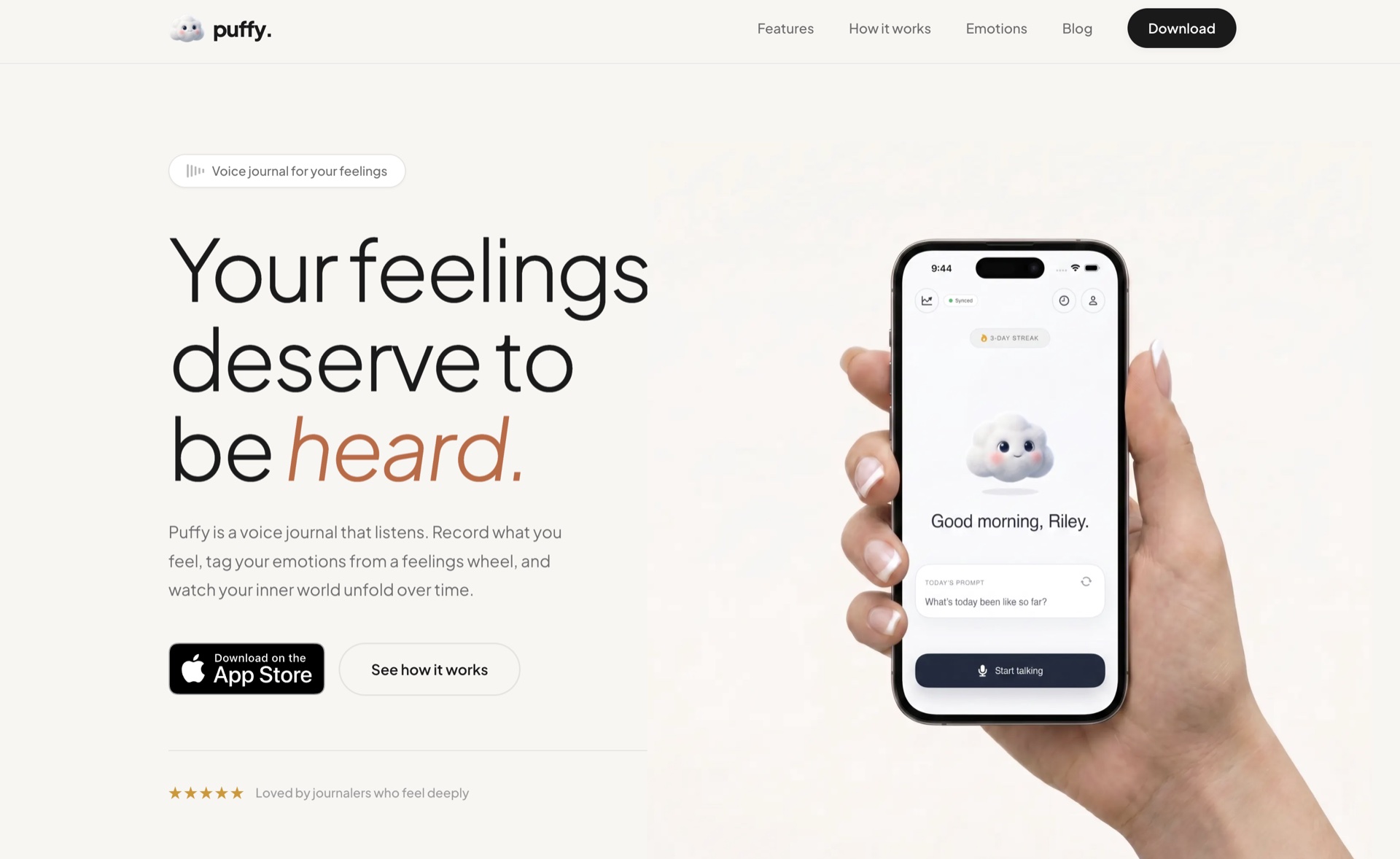
What it does: Puffy is a voice-first journaling app. You press record, speak about what is on your mind, and the app transcribes your words using AI. After each entry, a feelings wheel prompts you to identify your emotional state from six primary emotions and dozens of sub-emotions. Over time, Puffy visualizes your emotional trends.
Why it is good for mental health: Puffy combines two evidence-based practices into one app. The first is expressive disclosure, the act of articulating your thoughts and feelings out loud. James Pennebaker's research has shown that putting feelings into words (whether written or spoken) can reduce stress and improve emotional well-being. The second is affect labeling, the process of identifying and naming your emotions. Studies show that people who can label their emotions with specificity tend to regulate them more effectively. Puffy's feelings wheel directly supports this skill.
The voice-first design also removes a major barrier to consistent journaling. Many people abandon text-based journals because the effort of typing feels too high, especially during difficult emotional periods when journaling would be most beneficial. Speaking is faster, easier, and more accessible. You can journal while walking, commuting, or lying in bed.
The emotion trend visualizations add another layer of therapeutic value. Seeing your emotional patterns charted across weeks and months can reveal connections between events and feelings that you might not notice in the moment. This kind of pattern recognition is central to many therapeutic approaches, including cognitive behavioral therapy.
Pricing: Free.
Platforms: iOS.
One-line verdict: The best option for people who want to process emotions by speaking and track their feelings with genuine depth.
2. Rosebud: Best for Guided AI Journaling
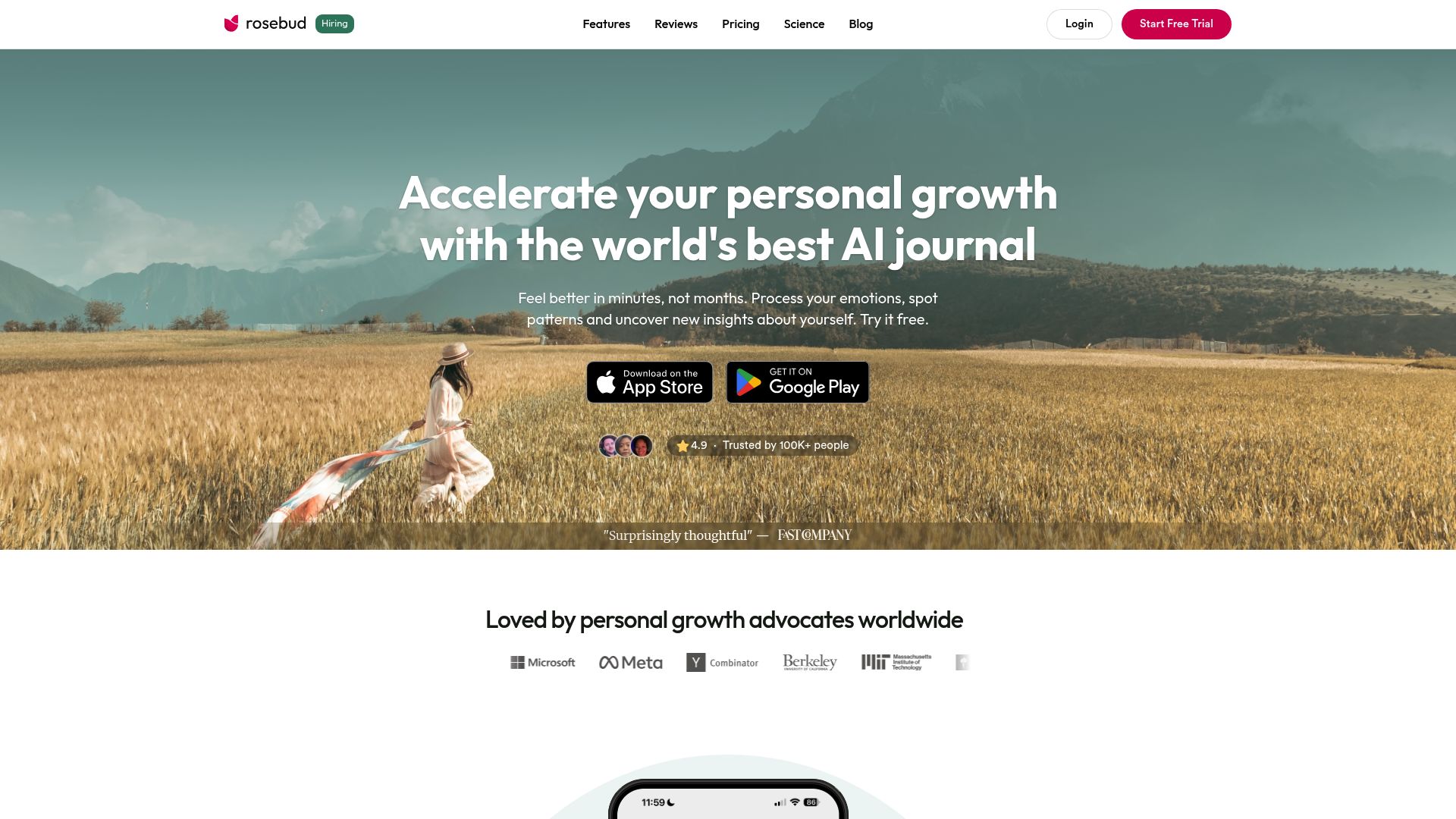
What it does: Rosebud is a chat-based journaling app where an AI guides you through structured prompts and follow-up questions. You type about your day, and the AI responds with thoughtful questions designed to deepen your reflection. The app also generates insights based on your entries over time.
Why it is good for mental health: Many people struggle with the blank page problem: they know journaling would help, but they do not know where to start or what to write about. Rosebud eliminates this barrier entirely. The AI always has a question ready, and the questions are designed to promote self-reflection rather than surface- level reporting.
Rosebud also offers prompt libraries organized around specific therapeutic goals: managing anxiety, processing grief, building gratitude, setting boundaries, and more. This makes it easy to incorporate structured therapeutic exercises into your journaling practice without needing to design the exercises yourself.
The AI-generated insights can help you identify patterns you might miss. If you have been writing about work stress every day for two weeks, Rosebud will surface that theme. For people who benefit from external reflection, this can be genuinely valuable.
Pricing: Free tier with limited entries. Premium at $5.83/mo (billed annually).
Platforms: iOS, Android, Web.
One-line verdict: The best choice for people who want an AI-guided journaling experience and benefit from structured prompts.
3. Day One: Best for Multimedia Reflection
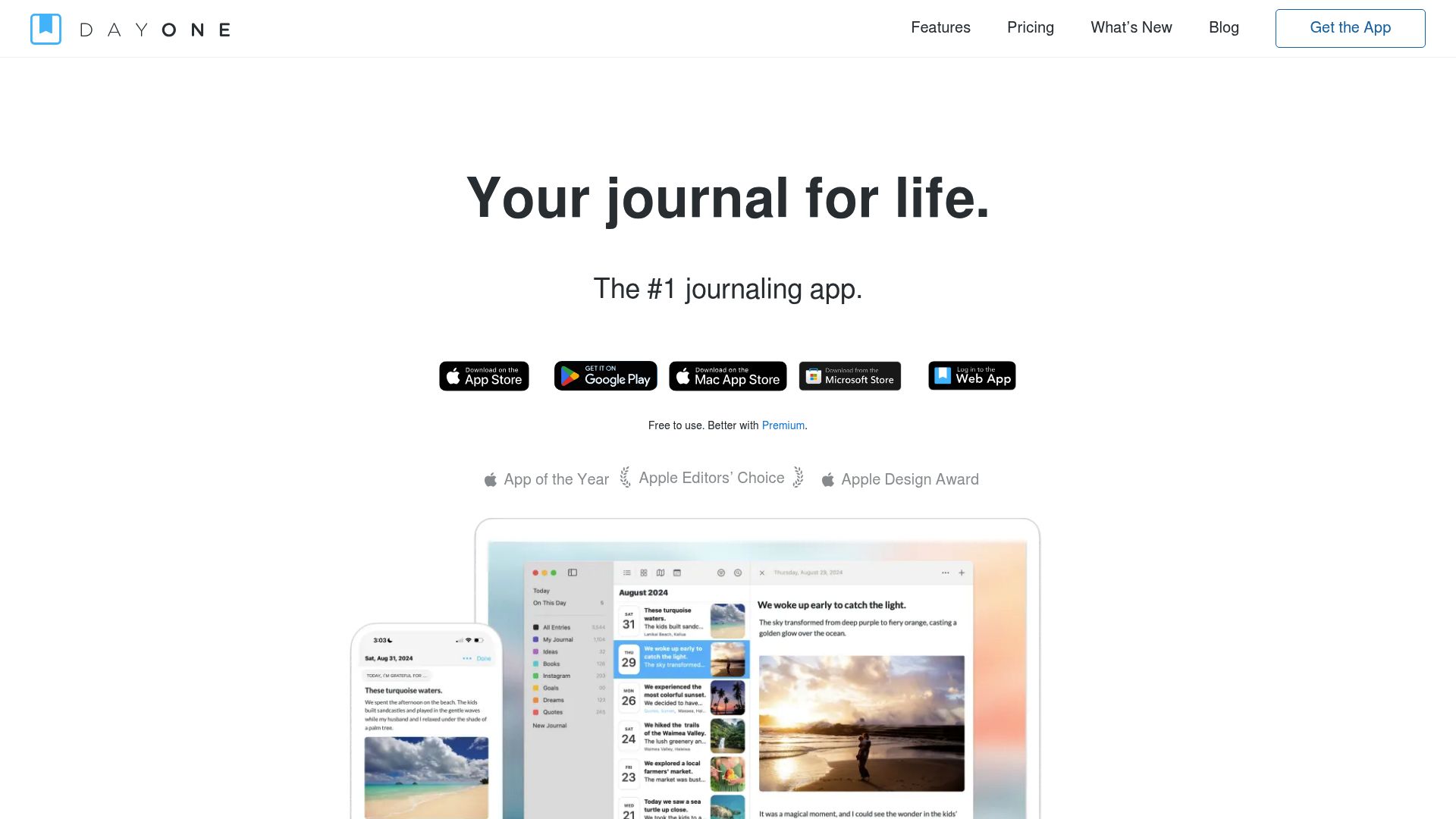
What it does: Day One is a full-featured journaling app that supports rich text, photos, videos, audio recordings, location data, weather information, and more. It is the most mature journaling app on the market, available across nearly every platform.
Why it is good for mental health: Day One excels at comprehensive life documentation, and for some people, this is therapeutic. The ability to create entries that combine written reflection with photos from your day creates a rich, multisensory record of your experiences. The "On This Day" feature, which surfaces entries from the same date in previous years, encourages the kind of longitudinal reflection that helps you recognize growth, process recurring challenges, and appreciate how far you have come.
Day One does not include dedicated emotion tracking or therapeutic prompts, but its flexibility means you can use it for any style of reflective writing. Many therapists recommend free-form journaling as a way to process difficult experiences, and Day One provides an excellent canvas for that practice.
Pricing: Free tier available. Premium at $4.17/mo (billed annually).
Platforms: iOS, Android, Mac, Windows, Web.
One-line verdict: The best journal for people who want a richly featured writing environment and value photos and memories alongside reflection.
4. Reflectly: Best for Quick Mood Tracking
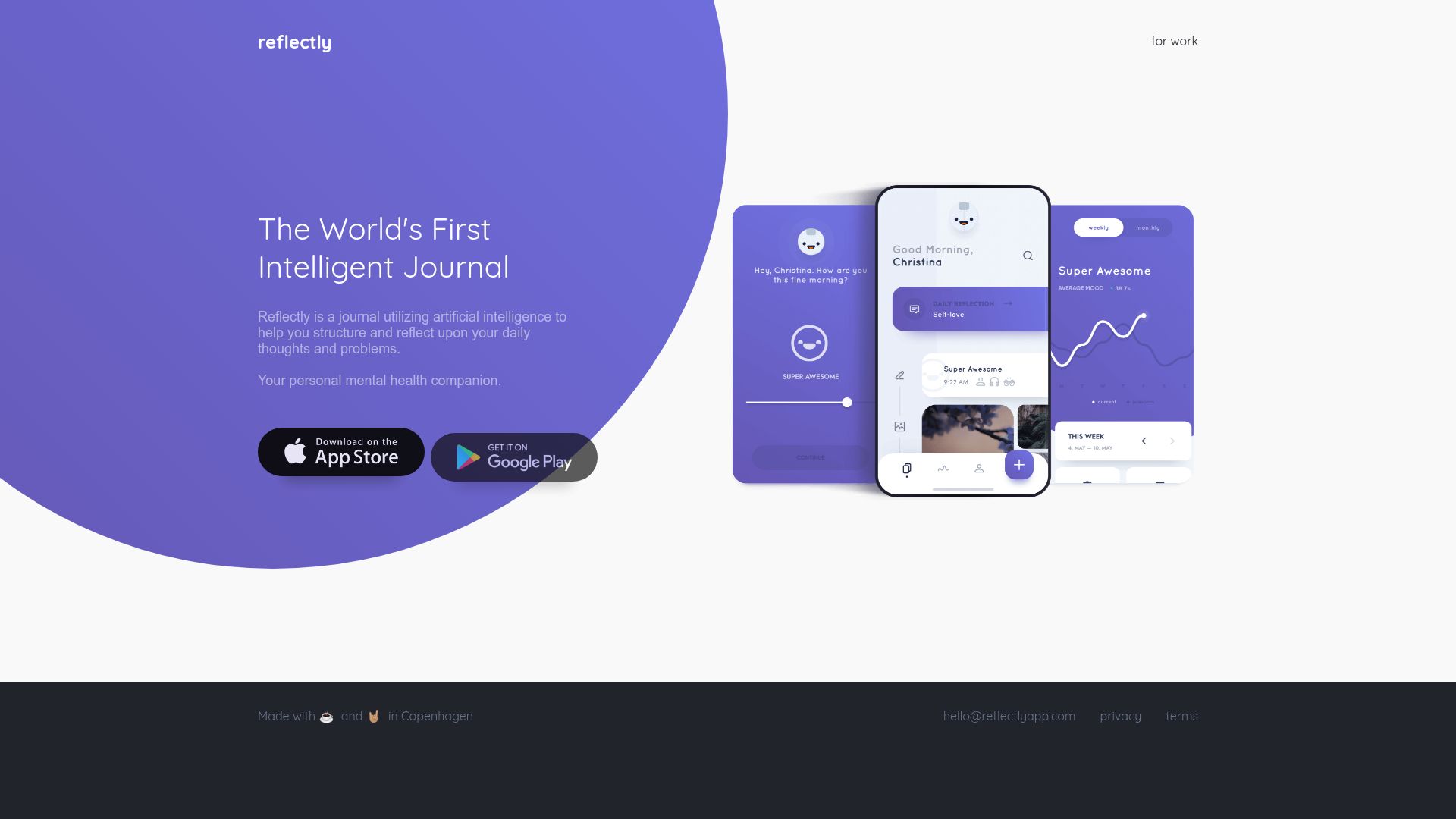
What it does: Reflectly is a mood tracking and journaling app with AI-generated prompts. You select your current mood, answer a short prompt, and the app tracks your emotional patterns over time. The interface is colorful and inviting, designed to make daily check-ins feel easy and pleasant.
Why it is good for mental health: Reflectly's greatest strength is its low barrier to entry. A journal check-in takes one to two minutes. For people who are struggling with motivation, energy, or time, this minimal commitment can be the difference between journaling and not journaling at all. The AI prompts encourage positive reflection, which can be helpful for people dealing with negative thought patterns.
The mood tracking, while simpler than what Puffy offers, still provides value. Seeing your mood charted over weeks can help you identify triggers and patterns. Even a basic "good day / bad day" record becomes useful over time if you are consistent with it.
Pricing: No meaningful free tier. Starting at $9.99/mo.
Platforms: iOS, Android.
One-line verdict: A polished, low-effort option for people who want a quick daily mood check-in with guided prompts.
5. Stoic: Best for CBT and Philosophy-Based Journaling
What it does: Stoic is a journaling and mental health app that blends Stoic philosophy with cognitive behavioral therapy (CBT) techniques. It offers morning and evening routines, breathing exercises, mood tracking, gratitude prompts, and structured reflective exercises based on Stoic teachings and evidence-based psychological practices.
Why it is good for mental health: Stoic is one of the few journaling apps that explicitly incorporates therapeutic frameworks into its design. The CBT-informed prompts help you examine thought patterns, challenge cognitive distortions, and reframe negative thinking. The Stoic philosophy angle adds a contemplative dimension that many users find grounding.
The app's morning and evening routines create a natural bookend structure for your day. The morning routine focuses on intention-setting and preparation for challenges. The evening routine focuses on reflection and gratitude. This structure mirrors practices recommended by many therapists for managing anxiety and building resilience.
Stoic also includes breathing exercises and meditation timers, making it a more holistic mental wellness tool rather than just a journal. If you want a single app that covers journaling, meditation, and structured self-improvement exercises, Stoic delivers a comprehensive package.
Pricing: Free tier available. Premium at $4.99/mo.
Platforms: iOS, Android.
One-line verdict: The best choice for people who want structured CBT exercises and Stoic philosophy integrated into their journaling practice.
6. Daylio: Best for Tap-Based Mood Tracking
What it does: Daylio is a mood tracker and micro-diary that lets you log your mood and activities without writing a single word. You select a mood icon, tap the activities you did that day (like exercise, work, socializing, or cooking), and optionally add a brief note. The app then tracks correlations between your activities and your mood over time.
Why it is good for mental health: Daylio removes the biggest obstacle to consistent mood tracking: writing. Some people, especially those dealing with depression or low energy, find even short text entries overwhelming. Daylio requires nothing more than a few taps. This makes it one of the most sustainable mood tracking approaches available.
The activity-mood correlation feature is genuinely useful. Over time, Daylio can show you that you tend to feel better on days when you exercise, or that your mood dips on days when you skip social interaction. These data-driven insights can inform behavioral changes in a way that feels concrete and actionable rather than abstract.
Daylio also offers detailed statistics and charts that let you see your mood distribution, streaks, and trends. The gamification elements (streaks, badges) help maintain consistency, which is critical for long-term mental health benefits.
The main limitation is depth. Because entries are primarily taps rather than words, you lose the therapeutic benefit of articulating your thoughts and feelings. Daylio tracks what you feel but does not help you process why you feel it.
Pricing: Free tier available. Premium at $4.99/mo.
Platforms: iOS, Android.
One-line verdict: The best mood tracker for people who want to log how they feel without writing anything at all.
7. Gratitude: Best for Gratitude Practice
What it does: Gratitude (also known as "Gratitude: Journal, Affirmations") is a journaling app focused specifically on gratitude practice and positive affirmations. It offers daily prompts for gratitude journaling, a vision board feature, positive affirmations, and milestone tracking. The design is warm and inviting, with a focus on cultivating a positive mindset.
Why it is good for mental health: Gratitude journaling is one of the most well-studied interventions in positive psychology. Research by Robert Emmons and others has consistently shown that regularly noting things you are grateful for is associated with increased happiness, reduced depression, better sleep, and stronger social relationships. The Gratitude app makes this practice straightforward and habitual.
The app's daily prompts remove the guesswork from gratitude journaling. Instead of trying to remember to be grateful, the app sends reminders and provides specific questions like "What is one thing that made you smile today?" or "Who is someone you are thankful for this week?" These targeted prompts are particularly helpful for people who find open-ended gratitude journaling difficult.
The affirmations feature is a nice complement. Positive affirmations, while not universally supported by research for all populations, can be beneficial for people with moderate self-esteem who want to reinforce positive self-beliefs. The vision board feature adds a goal-setting dimension that connects gratitude to forward-looking motivation.
The main limitation is scope. This is a specialized tool for gratitude and positivity. If you need to process difficult emotions like anger, grief, or anxiety, the Gratitude app is not designed for that purpose. It works best as a complement to a more comprehensive journaling or therapy practice.
Pricing: Free tier available. Premium at $4.99/mo.
Platforms: iOS, Android.
One-line verdict: The best app for building a dedicated gratitude journaling practice with daily prompts and affirmations.
How to Choose the Right App for You
With seven solid options on this list, choosing can feel overwhelming. Here is a framework for narrowing down your decision based on what matters most to you.
Start with your input preference
If you prefer speaking, start with Puffy. If you prefer typing with AI guidance, start with Rosebud. If you prefer tapping without writing, start with Daylio. If you prefer rich text with photos, start with Day One. Your input method determines whether you will actually use the app long-term. Pick the modality that feels most natural.
Consider what you need therapeutically
- For emotion identification and tracking: Puffy (feelings wheel) or Daylio (activity-mood correlation).
- For guided reflection and prompts: Rosebud (AI conversation) or Reflectly (daily prompts).
- For CBT techniques and structured exercises: Stoic.
- For gratitude practice: Gratitude.
- For comprehensive life documentation: Day One.
Think about consistency
The therapeutic benefits of journaling come from regular practice, not from any single entry. The "best" app is the one you will actually use five or six days a week. If a feature-rich app feels too heavy for daily use, choose something lighter. A two-minute Reflectly check-in done consistently is worth more than a 20-minute Day One entry done once a month.
A Note on Apps vs. Therapy
Journaling apps are tools for self-reflection, not replacements for professional mental health care. If you are experiencing severe anxiety, depression, or other mental health challenges, please reach out to a licensed therapist or counselor. Apps like the ones on this list can complement therapy beautifully. Many therapists actively encourage their clients to journal between sessions. But they are not a substitute for professional guidance when you need it.
If you are in crisis, contact the 988 Suicide and Crisis Lifeline (call or text 988 in the US) or your local emergency services.
Final Thoughts
Every app on this list can support your mental health in meaningful ways. The key is matching the app to your personality, your preferences, and the specific type of support you are looking for.
If you want to speak freely and track your emotions with depth, try Puffy. If you want an AI that guides your reflection, try Rosebud. If you want rich multimedia journaling, try Day One. If you want a quick daily mood check-in, try Reflectly. If you want CBT-based exercises, try Stoic. If you want effortless mood logging, try Daylio. If you want a dedicated gratitude practice, try Gratitude.
Most of these apps offer free tiers or free trials. Download two or three, use each for a week, and see which one sticks. The best journaling app for your mental health is, ultimately, the one that becomes part of your daily routine.