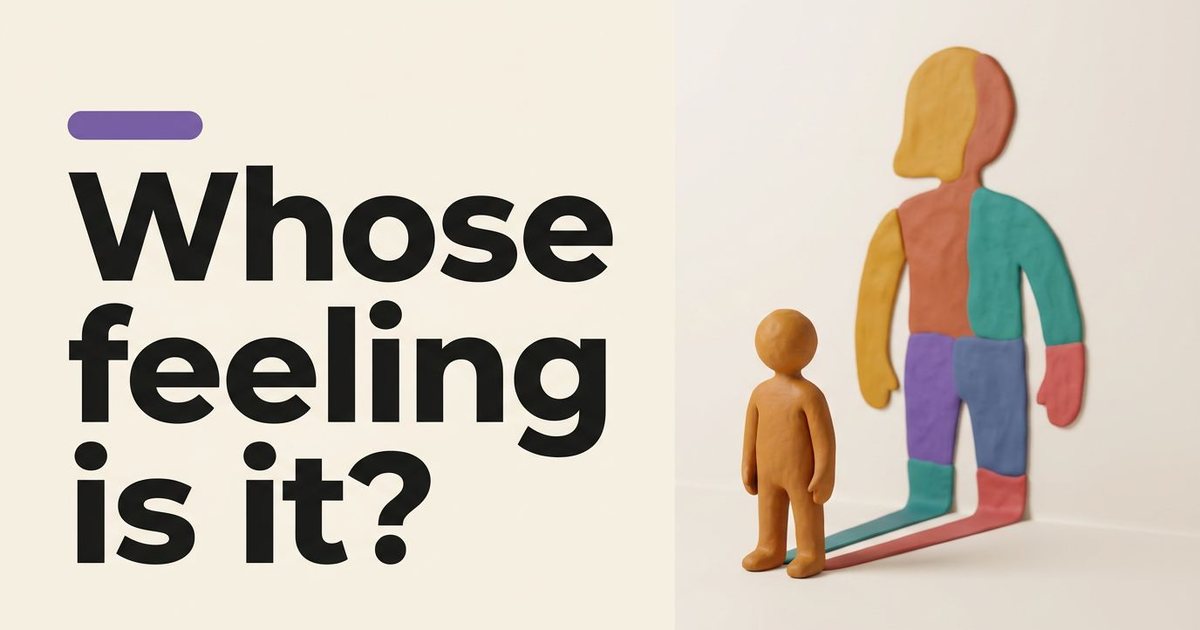
Projecting feelings means unconsciously attributing your own emotions, insecurities, or impulses to someone else. Instead of feeling I am angry, you experience you are angry at me.
If you are reading this after a fight, you are in good company. Maybe someone accused you of projecting, or maybe a small voice is wondering whether the fury you aimed at your partner tonight was really about them at all. Either way, understanding how projection works is one of the fastest routes to fewer confusing arguments and a clearer read on your own emotional life.
What Does Projecting Mean in Psychology?
The APA Dictionary of Psychology defines projection as attributing one's own traits, attitudes, or unacceptable impulses to another person. The concept began with Sigmund Freud, who described projection as a defense mechanism: when a feeling is too threatening to own, the mind pushes it outward and locates it in someone else. His daughter Anna Freud later developed the idea further, cataloguing projection alongside denial and repression as one of the core ways the ego protects itself from anxiety.
Modern psychology has kept the concept but updated the mechanics. Attribution research by Roy Baumeister and Leonard Newman in the 1990s suggested that projection works partly through attention. When you are trying to suppress an uncomfortable thought about yourself, that thought stays highly accessible in your mind, so you become quicker to spot the same trait in other people, whether or not it is actually there. In other words, projection is real, but it is less a mystical transfer of feelings and more a bias in what you notice and how you interpret it. You are primed to see in others exactly what you are working hardest not to see in yourself.
7 Signs You Might Be Projecting
Projection is slippery by design, so you rarely catch it in the act. But it leaves fingerprints. Run through this self check honestly. One or two occasional matches are normal. Several of them showing up regularly may be a sign that projection is doing more driving than you realized.
- Intense reactions to small triggers. A mildly worded text or a neutral comment sets off a response that surprises even you. When the emotional volume does not match the event, the extra charge is often coming from somewhere inside.
- Mind reading other people's feelings. You feel certain you know what someone thinks of you, without them saying a word. "She is clearly annoyed with me" or "he thinks I am a failure" arrive as facts, not guesses.
- Criticizing traits you fear in yourself. The qualities that most irritate you in others, such as neediness, laziness, or arrogance, are often the ones you are most anxious about owning.
- Insisting you are fine while acting otherwise. You say "I am not upset" through clenched teeth, then accuse the other person of being in a bad mood.
- The same fight recurring with different people. Different partner, different boss, different roommate, but somehow the same argument. When you are the common denominator, the script may be yours.
- Everything is someone else's fault. In your account of any conflict, you are always reacting, never initiating. A life story with no personal missteps in it usually has some editing.
- Disproportionate defensiveness around one topic. There is a subject, perhaps money, commitment, or competence, that you cannot discuss calmly. The topics we guard hardest tend to sit on top of the feelings we least want to look at.
Real-Life Examples of Projecting Feelings
Projection sounds abstract until you see it in ordinary moments. Here are four scenarios that show how it plays out in daily life.
The jealousy that came from within
Maya keeps grilling her boyfriend about a coworker he mentioned twice. The relationship is solid and he has given her no reason to doubt him. What Maya has not admitted to herself is that she has been enjoying attention from someone at her own office a little too much. The guilt she cannot face in herself becomes suspicion she aims at him.
The boss who was never annoyed
Dev sends his manager a report and gets back a one line reply: "Thanks, will review." He spends the afternoon convinced she is disappointed, rereading the message for hidden coldness. The disappointment is real, but it is his own. He knows the report was rushed, and rather than sit with that feeling, his mind relocates it into his manager's two word email.
The parent's fear in the child's backpack
A father who was bullied in school keeps asking his cheerful eight year old whether the other kids are being mean to her. She is fine. He is not. His old fear gets projected onto her school days, and over time she may start scanning for threats that were never hers, simply because someone she trusts keeps insisting they must be there.
The friend who called you distant
A friend accuses you of pulling away: "You never make time for me anymore." When you check the record, you have initiated the last four hangouts. They are the one who has been slow to reply and quick to cancel. Their guilt about withdrawing is easier to carry as a complaint about you. This one matters because it shows projection from the receiving end, which we will come back to below.
Why People Project
Like a lot of aspects of human behavior, projection comes down to self defense. Certain feelings, such as shame, envy, anger at someone we love, or fear of being unlovable, can feel genuinely dangerous to admit. Projection is the mind's way of getting some distance: the feeling still gets expressed, just with the return address changed.
Several ingredients make projection more likely:
- Shame. The more unacceptable a feeling seems, the stronger the pressure to disown it and find it somewhere else.
- Low emotional vocabulary. If you cannot name what you are feeling, it is much harder to recognize it as yours. Vague inner static gets misread as coming from other people. Building what researchers call emotional granularity, the ability to distinguish irritation from disappointment from anxiety, directly weakens this pathway.
- Old wounds. Feelings we were punished or mocked for expressing as children often become the ones we can only experience secondhand as adults.
- Stress and depletion. Self awareness takes energy. When you are exhausted, anxious, or stretched thin, the mind reaches for its cheapest defenses first, and projection is one of the cheapest.
Here is the compassionate truth: everyone projects sometimes. It is not a character flaw or a disorder, it is a standard feature of having a mind that protects itself. There is no need to beat yourself up about it. The goal is not to never project again, it is to catch it sooner, repair faster, and slowly shrink the pile of feelings you cannot afford to own.
How to Stop Projecting: 6 Steps
You cannot stop a defense mechanism by willpower alone, but you can build habits that catch it earlier and earlier. A quick note before the steps: this article is informational only and is not a substitute for professional mental health advice. If projection is damaging your relationships, a licensed therapist can help you work through what is underneath it.
- Pause before reacting. Projection lives in the gap between trigger and response, and that gap is usually about half a second long. Stretch it. Take one slow breath before you answer the text or fire back in the argument. You are not trying to suppress the feeling, only to buy your prefrontal cortex enough time to ask whose feeling it is.
- Name the feeling out loud. Say it plainly, even alone in the car: "I am feeling humiliated right now." Affect labeling research shows that putting emotions into spoken words reduces their intensity, and a feeling you have named as yours is much harder to pin on someone else. If you want the deeper science, we cover it in our article on why talking helps process emotions.
- Check the evidence. Split your account of the situation into two columns: what you actually know versus what you are assuming. "He did not text back for three hours" is knowledge. "He is losing interest" is an assumption. Projection lives almost entirely in the second column.
- Journal the pattern. Single moments of projection are hard to spot, but patterns across weeks are unmistakable. After a conflict, work through prompts like these:
- Whose feeling is this?
- When have I felt what I am accusing them of?
- What would I think if a friend described this fight?
- What am I afraid is true about me?
- What did I need in that moment?
- Repair quickly when you catch it. When you realize mid argument that the anger was yours, say so: "Wait, I think I am putting something on you that is actually mine. I am sorry." This is disarming, it rebuilds trust fast, and it trains your brain that owning a feeling is survivable, which makes the defense less necessary next time.
- Ask instead of assuming. Replace mind reading with curiosity. Instead of "you are obviously mad at me," try "how are you actually feeling about this?" You will be wrong about other people's inner states far more often than you think, and asking is the only reliable correction.
What If Someone Is Projecting Onto You?
Being on the receiving end of projection is disorienting. You get accused of feelings you do not have and motives you never held, and the accusation arrives with total confidence. The first step is simply recognizing it: if a charge feels wildly out of sync with anything you actually did or felt, and especially if it describes the other person's recent behavior better than yours, projection may be in play.
The second step is refusing to absorb it. Other people's disowned feelings are not yours to carry, and you do not have to accept a distorted picture of yourself just because someone painted it with conviction. A calm boundary works better than a counterattack. Try something like: "That does not match my experience. I was not angry, but it sounds like something is bothering you. Do you want to talk about it?" Or, if things are heated: "I am not going to accept being told what I feel. I am happy to keep talking when we can both speak for ourselves."
Finally, stay curious rather than defensive when you can manage it. Projection is usually a clumsy confession, and meeting it with gentle curiosity sometimes opens a real conversation where a counterpunch would only start round two.
Projection, Deflection, and Gaslighting: What Is the Difference?
These three terms get tangled together online, but they describe different things.
- Projection assigns your feeling to someone else. "You are so angry at me" from the person who is actually angry. It is about the content of emotions, and it is usually unconscious.
- Deflection redirects attention away from your behavior. "Well, what about the time you forgot my birthday?" It is about dodging accountability, and it can be quite deliberate. You can deflect without projecting a single feeling.
- Gaslighting is a sustained pattern of making someone doubt their own perception, memory, or sanity. "That never happened, you are imagining things, you always overreact." It is a form of psychological manipulation, not a one off defensive reflex.
The overlap is real but limited. A person who gaslights may use projection as one of their tools, but the vast majority of everyday projection is not gaslighting. The difference comes down to pattern and intent: a reflex that distorts one moment versus a campaign that erodes someone's grip on reality.
When Projection Points to Something Bigger
Occasional projection is part of being human. But if you notice that it is chronic, that the same accusations keep surfacing, that relationships keep collapsing under fights nobody can explain afterward, or that there are feelings you seemingly cannot experience as your own at all, that pattern may be a sign of deeper unresolved material, such as longstanding shame or earlier relational wounds. None of that means something is wrong with you as a person. It means the self protective habits that once kept you safe are now costing more than they save.
This is exactly the territory where working with a licensed therapist pays off. A good therapist offers something a defense mechanism cannot survive: a relationship where owning your least flattering feelings is met with acceptance instead of punishment.
To be clear one more time: this article is for informational purposes only and is not a substitute for professional mental health advice, diagnosis, or treatment. If projection is damaging your relationships or your wellbeing, please reach out to a licensed mental health professional.
Frequently Asked Questions
Is projecting a red flag?
On its own, no. Everyone projects occasionally, and a person who projects sometimes but can recognize it and repair afterward is simply human. It becomes a genuine concern when projection is constant, when the person never entertains the possibility that a feeling is theirs, or when accusations are used to blame and control you. Judge the pattern and the repair, not the single moment.
Is projection conscious or unconscious?
Mostly unconscious. That is what makes it a defense mechanism rather than a lie: the person genuinely experiences the feeling as belonging to someone else. The good news is that awareness can be trained. With journaling, honest feedback, or therapy, many people learn to catch projection within minutes instead of never.
What is the difference between projecting and deflecting?
Projection misassigns a feeling: you are angry, so you accuse someone else of being angry. Deflection dodges accountability: you are criticized, so you change the subject or bring up the other person's flaws. Projection is about where emotions get located, deflection is about where attention gets directed. They often appear together in the same argument, but they are separate moves.
Is projecting the same as gaslighting?
No. Projection is typically an unconscious, momentary defense. Gaslighting is a repeated pattern of manipulation aimed at making someone distrust their own perception and memory. Someone who projects onto you is usually confused about their own feelings. Someone who gaslights you is working to make you confused about yours. If you are experiencing the latter, that is worth taking seriously and discussing with a professional you trust.